
Aaron Foyer
Director, Research
Aaron Foyer
Director, Research
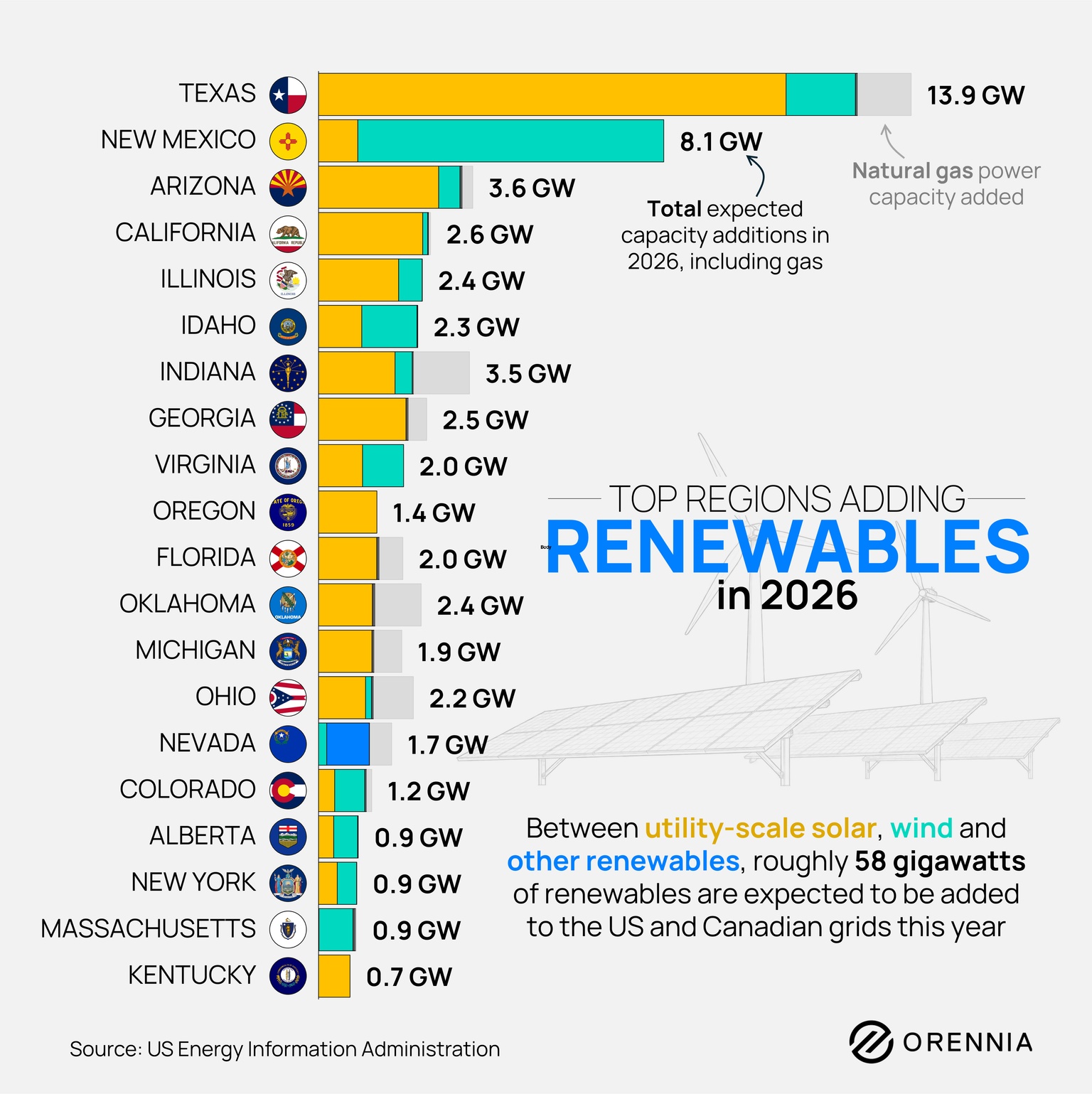
America's 2026 build-out has a clear pecking order, and solar is sitting on top of it.
There is 58 gigawatts of renewable generating capacity expected to be added to the US and Canadian grids this year, with solar accounting for nearly 70% of it. That works out to be ~43 gigawatts of new utility-scale solar, a 44% jump from last year, if everything gets built.
Batteries are following solar in the Sun Belt: Texas, California and Arizona account for about 65% of new storage projects coming online this year. Wind mounted a bit of a comeback this year, with 16.7 gigawatts planned, more than double last year’s total.

The US Energy Information Administration projects renewables to account for 27% of American power generation by 2027.
The data center pull: The One Big Beautiful Bill Act (OBBBA) pulled back the long-term incentives for most renewables. Under the act, projects had to begin construction by July 4, 2026, or be placed in service by the end of 2027 to keep their credits.
But demand had its own plan, with Goldman Sachs Research expecting US data center power demand to climb from 31 gigawatts last year to 41 gigawatts in 2026 and 66 gigawatts next year. With gas turbine delivery times stretching past four years, speed is working in renewables' favor.
We’ve now reached a moment where building a power plant is the easy part. Plugging into the grid is the hard part.
About 8,200 projects were waiting in US interconnection queues at the end of 2025, representing 1.3 terawatts of generation and roughly 749 gigawatts of storage. For projects built in 2025, the average wait from request to operation was more than five years.
And the mix is shifting, with gas in the queue jumping 86% to 253 gigawatts, while solar, storage and wind all shrank. Even approved projects are stuck in traffic, since 549 gigawatts already have a draft or executed interconnection agreement but have not yet reached commercial operation.
Insights for an evolving energy landscape delivered to your inbox.