
Aaron Foyer
Director, Research
Aaron Foyer
Director, Research
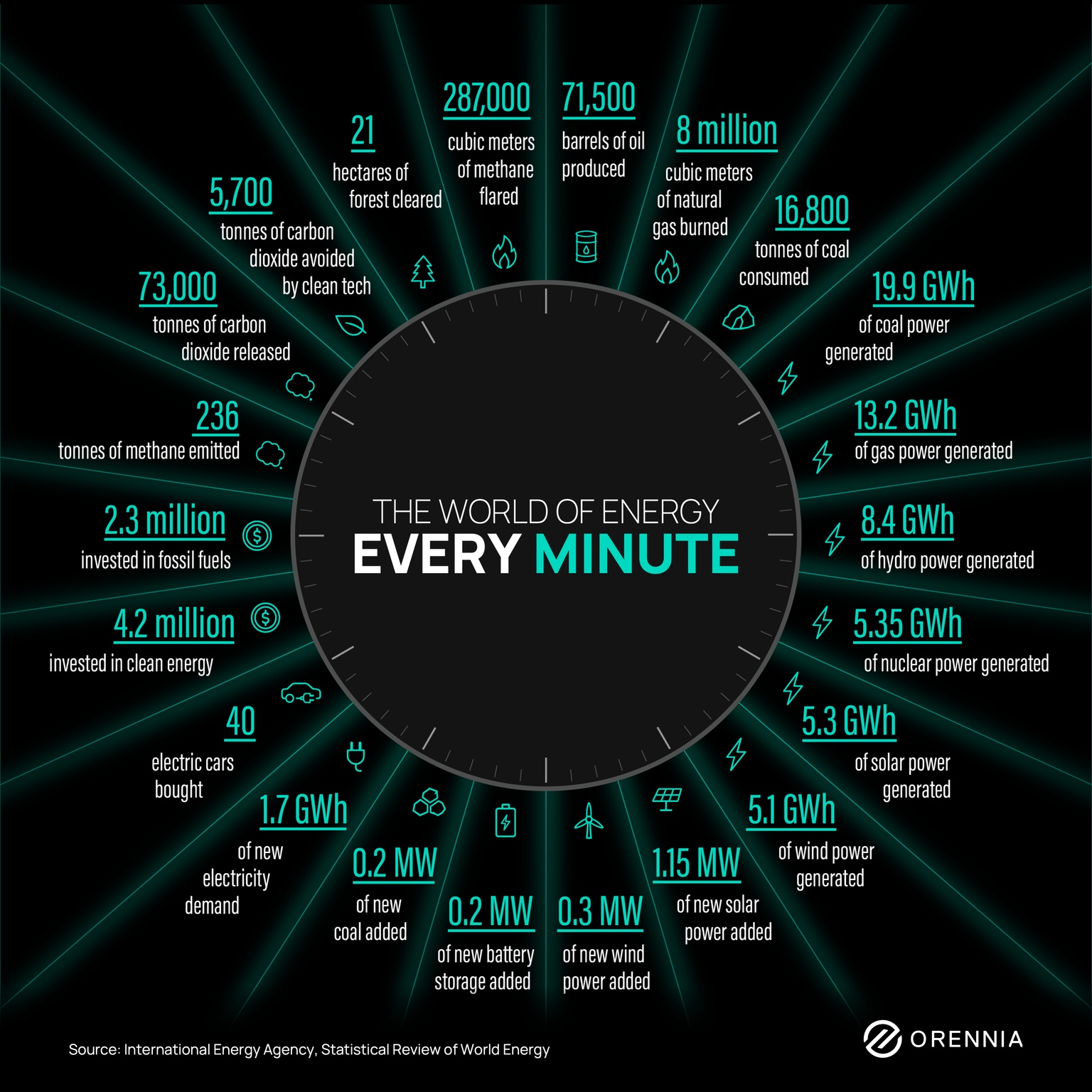
The global energy system is one of the largest and most complex systems ever built, supporting everything from manufacturing and transportation to heating, cooling and digital infrastructure.
The financial scale is just as significant: the International Energy Agency estimates that global energy investment will reach roughly $3.4 trillion in 2026, with about $2.2 trillion going toward clean energy, grids, storage, efficiency and electrification versus $1.2 trillion for fossil fuels.
The IEA also highlights that electricity-related spending now accounts for 60% of all global energy investment.
The global electricity mix has changed considerably over the past 25 years, particularly with the growth of wind and solar power.
In terms of capacity being added to global grids, wind and solar account for the majority of additions. Renewables account for more than 70% of total power generation spending, including ~$1 billion per day for solar projects.

In 2000, wind and solar together generated less than 1% of the world's electricity. By 2025, their combined share had reached 17%. Renewables as a whole overtook coal in 2025 for the first time in more than a century, supplying 33.8% of global electricity compared with coal's 33.0%.
But the shift is not complete: fossil fuels still provide the majority of electricity globally, and coal and natural gas remain the two largest individual sources.
Every minute, the world generates 33.1 gigawatt-hours of combined coal and gas power and just 10.4 gigawatt-hours of combined solar and wind power.
Insights for an evolving energy landscape delivered to your inbox.