
Aaron Foyer
Director, Research
What's already been implemented and potential impacts
Aaron Foyer
Director, Research
There might be no one who helped shape the modern world order more than Dwight D. Eisenhower. Before becoming president, Eisenhower served as the Supreme Allied Commander of Europe in World War II then later as the Supreme Commander of NATO at the start of the Cold War.
Reflecting on the difficulties of being an American president, Eisenhower talked about the role’s steep learning curve. “The presidency has many problems, but one of the worst is that you have no idea how much don’t know until you’re in it,” the 34th president said.
Like most two-term presidents, Eisenhower served consecutive terms, meaning his presidency was like an eight-year legislative marathon with an election in the middle. In this way, President Donald Trump is very different, being only the second American president ever to serve non-consecutive terms.
While Trump was acrimonious in his loss to Joe Biden, the break did give his team and the broader conservative movement a rare opportunity to sit back, do an audit about what worked and what didn’t, then spend time to carefully craft a manifesto for a second Trump term.
Armed with an understanding of the machinery of government from hands-on experience, the Heritage Foundation published Mandate for Leadership: The Conservative Promise in April 2023 that serves as the primary policy document for the 2025 Presidential Transition Project or, as it’s more commonly known, Project 2025.
Plausible deniability: The president has never publicly embraced Project 2025. In the run-up to the 2024 election, his campaign denied association with the plan. “I have nothing to do with Project 2025. That is out there. I have not read it. I don’t want to read it purposely. I’m not going to read it,” Trump said in the September 2024 presidential debate.
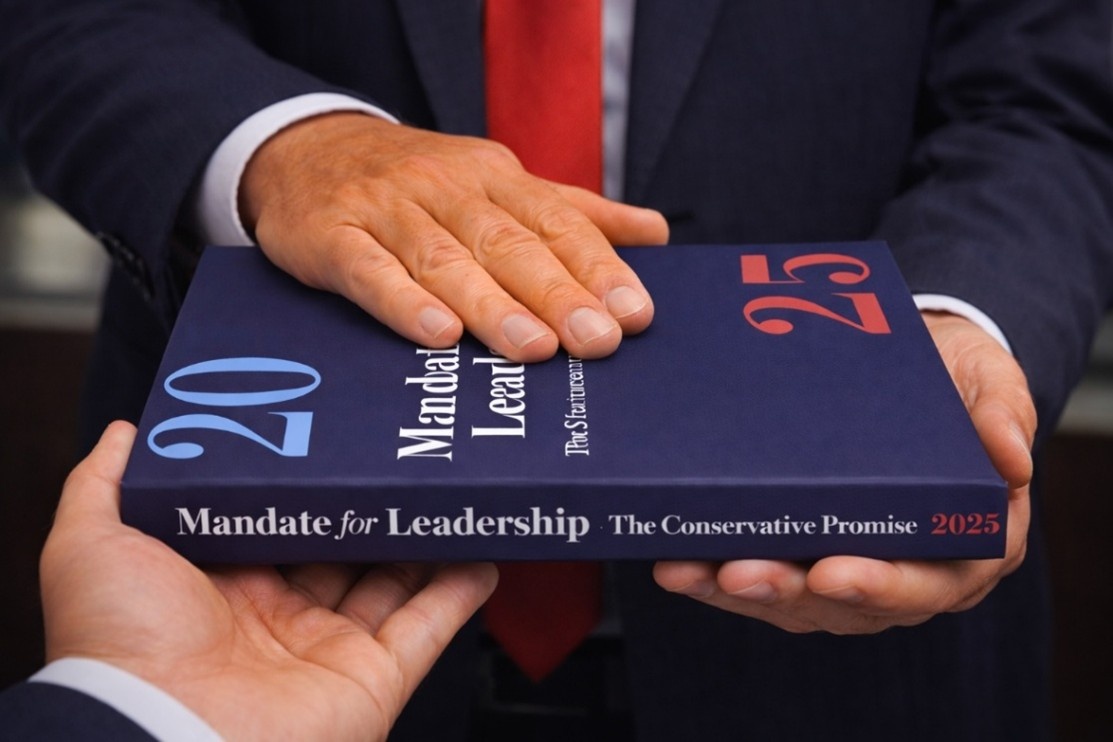
Source: DALL-E
And not that a candidate running for president would ever mislead the public in a debate, but coincidentally, 25 of the 40 authors that penned the policy document worked in the first Trump administration in high-level administrative positions and many now work in the second. Then vice-presidential nominee J.D. Vance wrote the initial foreword to the book before it was kiboshed because of the optics. And the chapter subtitle for the energy sector is “American Energy Dominance,” which just so happens to be the name of the new administration’s governing philosophy for the entire energy sector, verbatim.
With yesterday marking the one-year anniversary of the president being sworn in, it’s worth taking stock of progress being made on Project 2025 energy sector policy recommendations to shed light on what we might expect to see in 2026. Let’s dive in.
For those who haven’t read the Project 2025 policy piece (and who’d blame you; it’s 920 pages), the first obvious question is what are the main goals? On the energy front, it’s fundamentally about rejecting American energy as a means to achieve climate policy and instead embracing it as a source of strategic power.
Energetic leverage: “American energy dominance will allow the United States to secure energy for its citizens, markets for its energy exports, and access to new energy natural resources and will provide tools for US policymakers to assist our allies and deter our adversaries,” the authors wrote.

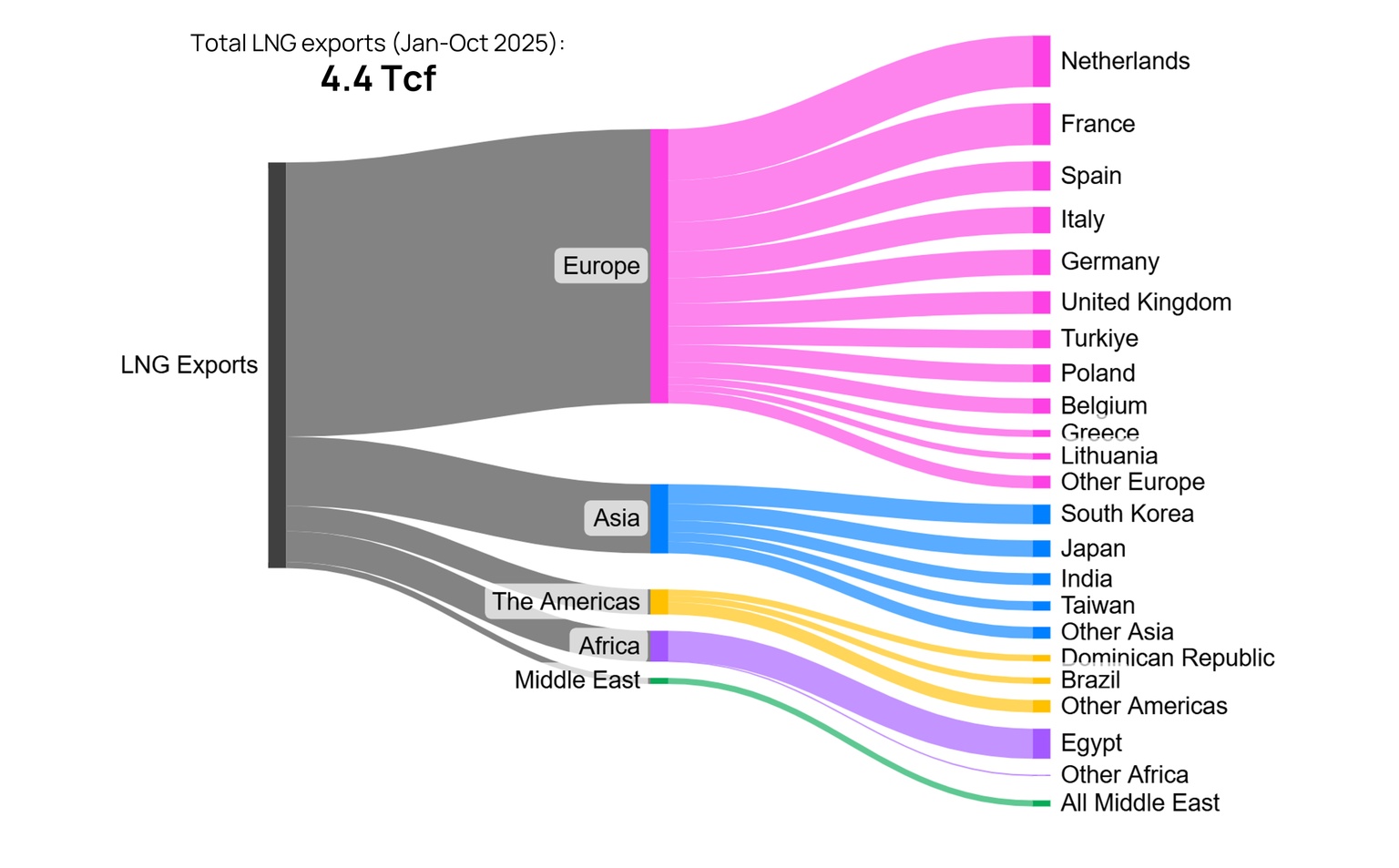
Liquefied natural gas, where the US is already the world’s largest exporter, is a perfect example. Countries become more dependent on America the more it sells them energy, just as Russia held leverage over Europe through its own gas supplies. For this reason, the administration is looking to expand its LNG exports.
On his first day in office, the president signed an executive order to end a pause the Biden administration had placed on new LNG export facility approvals. The Department of Energy later eased export permit extensions, removed bunkering barriers to using LNG as a marine fuel and even offered favorable loans to upcoming American LNG projects.
Reliability focus: One of the key tenets of Project 2025 energy policy is that renewables have made the grid unreliable and that a new administration should do everything it can to re-prioritize reliability in the system.
In part, that called for an end to federal subsidies for renewables. That is a fait accompli, as tax credits for wind and solar projects were wound down quickly with the One Big Beautiful Bill Act passed in July.
Source: US Energy Information Administration
It also called for support of projects and infrastructure that the Heritage Foundation deemed to be reliable. The clean power tax credits that were preserved in the OBBB were for baseload power projects, like nuclear and geothermal. In September, the DOE published its Speed to Power initiative to accelerate large-scale grid infrastructure projects. And later in December, the House passed the Power Plant Reliability Act that gives the Federal Energy Regulatory Commission authority to order coal plants to stay open.
Rome wasn’t built in a year and neither was Trump’s new world order. But last year did lay the foundation of US power through its energy sector: both physical and system power.
Physical power: Looking through a lens of technology, the US is seen as the nation of cutting-edge innovation via Silicon Valley. But viewed through an energy lens, the picture flips. America starts to resemble a sclerotic incumbent like Hewlett Packard, caught flat-footed as Chinatech, the gritty upstart, races ahead designing and manufacturing the next generation of energy technologies.
As a result, the US is now playing catch up, starting by building out supply chains for key inputs like critical minerals. This has involved embracing a state-sponsored capitalist approach, with the government investing and taking stakes in private companies, including a public-private partnership between the Department of Defense and MP Materials, and an investment into Trilogy Metals, a deal that comes with expedited mining permits.
The administration is also openly pushing to build more nuclear power. But the industry must find a way to curb costs, which have been climbing for decades compared to other countries. Rising costs have often been blamed on cumbersome regulations, with Project 2025 advocating to “streamline the nuclear regulatory requirements and licensing process.”
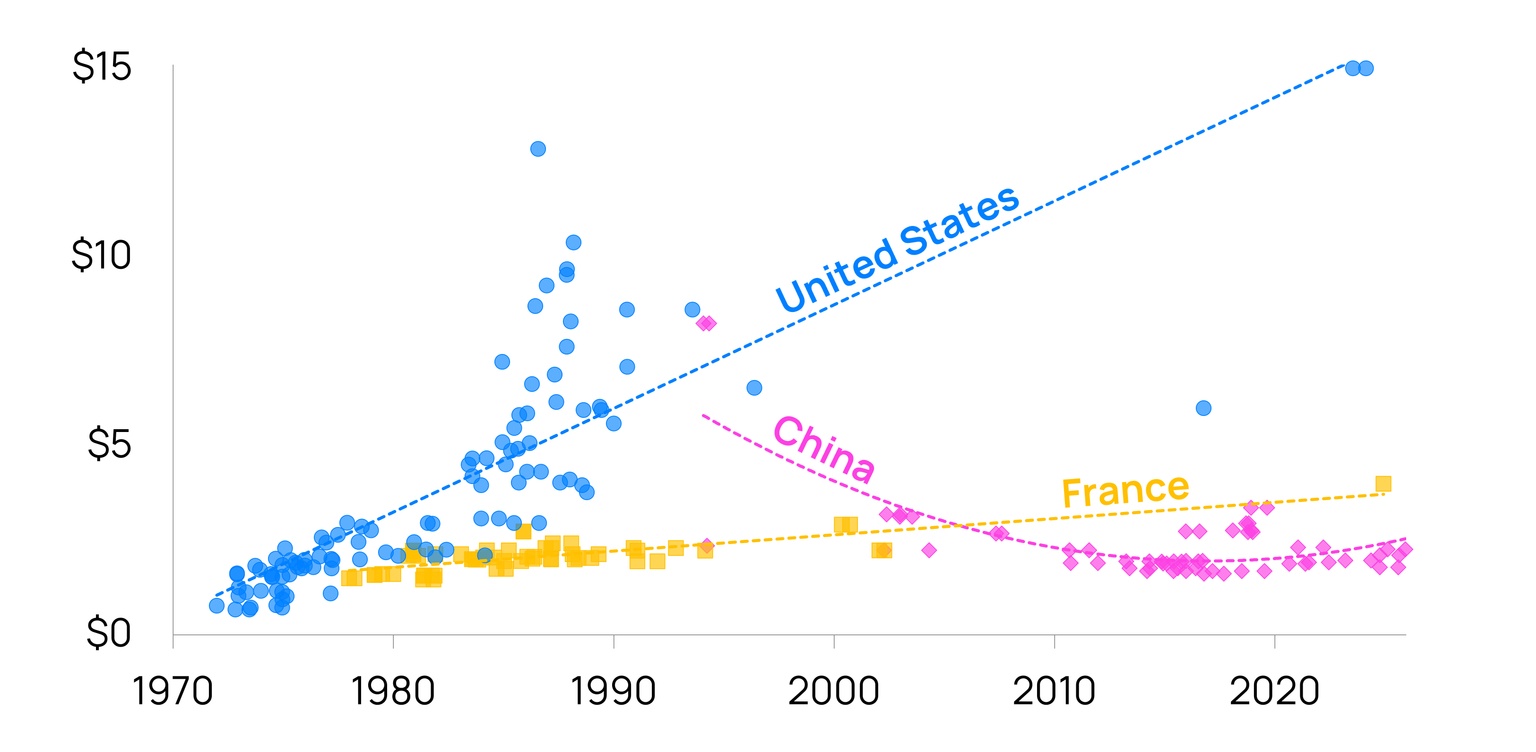
Source: Lui et al. (2025)
With that in mind, the president passed an executive order in May to reform the Nuclear Regulatory Commission and speed up license approvals to under 18 months for new reactors. The White House later signed the Atlantic Partnership for Advanced Nuclear Energy with the UK that expedites approvals for reactors in one country that have gone through rigorous safety checks in the other.
System power: At the heart of the “America First” belief system that many Republicans have embraced are instincts about power, sovereignty and obligation that the US should put domestic needs first. “The next Administration should make US energy dominance a key component of its foreign policy while ensuring that domestic and international goals are aligned,” reads Project 2025.
Any outside influence on its strategic energy sector, whether voluntary, like international efforts to address climate change, or involuntary, like cyberattacks that could take down the American power grid, are hostile to the ethos.
In his first couple of weeks back in the White House, the president signed an executive order to once again withdraw the United States from the Paris Agreement and then another to review the US’ participation in all international organizations and whether they run against US interests.
A perfect example of this is the International Maritime Organization, a UN organization that was set to vote on a net-zero fuel mandate last fall that had near universal support. But since this runs up against the US being able to make its own choices by eventually limiting the fuel options of international shippers, many of whom port and bunker in the US, the administration threatened retaliation to any supporters and succeeded in delaying the vote.
And worried about foreign attacks on the US grid, the Federal Energy Regulatory Commission unanimously approved a suite of actions to protect the nation’s power systems against cyberattacks and supply chain issues.
There are some goals that were kicked off last year with executive orders but take more time to legislate that will likely show up this year:
Overhauling nuclear approvals. Changing how agencies conduct reviews under the National Environmental Policy Act. Weakening the ability for states to block energy projects. Rolling back fuel economy standards. Scrapping the greenhouse gas reporting program for large emitters. Eliminating the Endangerment Finding that gives the EPA much of its power. Overturning mercury and air toxics standards. Revoking energy efficiency standards.
And there are some hints in Project 2025 about more ambitious plans.
Promoting American energy interests: The authors make no qualms that having security over an abundant supply of energy and natural resources is in America’s best interests.
“The next Administration should make US energy dominance a key component of its foreign policy while ensuring that domestic and international goals are aligned. American energy dominance will allow the United States to secure energy for its citizens, markets for its energy exports, and access to new energy natural resources and will provide tools for US policymakers to assist our allies and deter our adversaries,” the authors wrote.
The Trump administration made no attempt to mask that toppling Venezuelan dictator Nicolás Maduro earlier this year was to gain access to Venezuela’s oil reserves. And why lie? That’s its stated public geopolitical energy strategy.
And for those who think all the hard talk around Greenland is just more Art of the Deal from Trump for some concessions, Project 2025 is very clear on its position about the Arctic.
Chilling views: “The next Administration needs to define American strategic and economic interests in the Arctic Circle… In particular, this means identifying US energy interests in the Arctic Circle, identifying foreign government and commercial interests and activity in the region, and ensuring that the United States does not forgo important energy and national security interests in the Arctic,” reads the report.
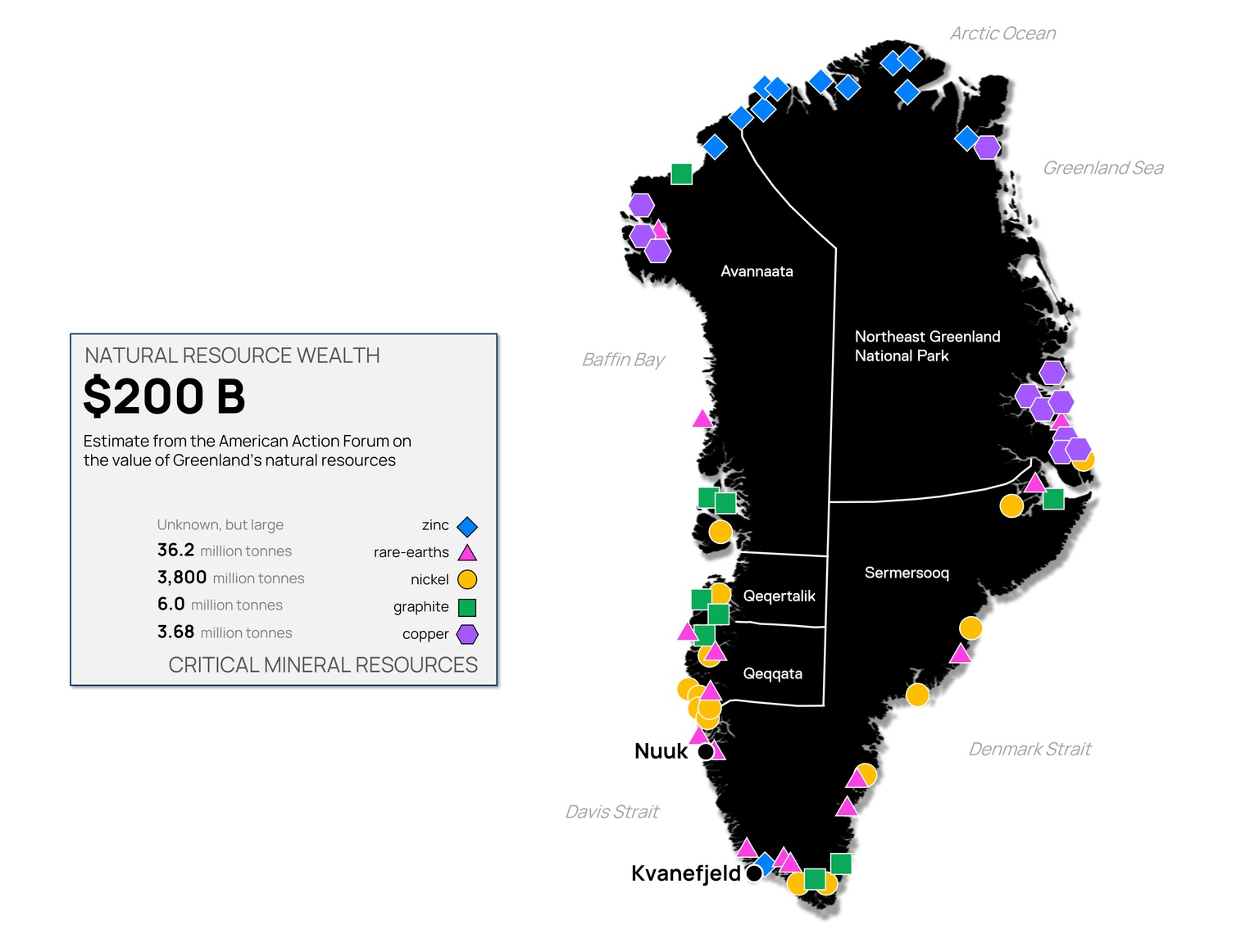
Source: Government of Greenland, Geological Survey of Denmark and Greenland, American Action Forum
To avoid painting the Project 2025 authors like the Starship Troopers, they clearly advocate for energy resources as a means to assist the US and its allies, regularly listing Canada and Europe as key allies. So annexing Greenland via a military coup would seem to run in the face of Project 2025.
Either way, by hook or by crook, it seems likely that the US will ultimately control Greenland by the end of the Trump administration.
The four-year break from office gave Trump, or at least key people around him who work for him again, a rare chance to plan and strategize a second term.
With his disruptive instincts, a rubber-stamping Congress and an unobstructive Supreme Court, Project 2025 could help make Trump the most revolutionary president in American history. Undoing the world order that President Eisenhower once helped create.
Insights for an evolving energy landscape delivered to your inbox.