
Aaron Foyer
Director, Research
Aaron Foyer
Director, Research
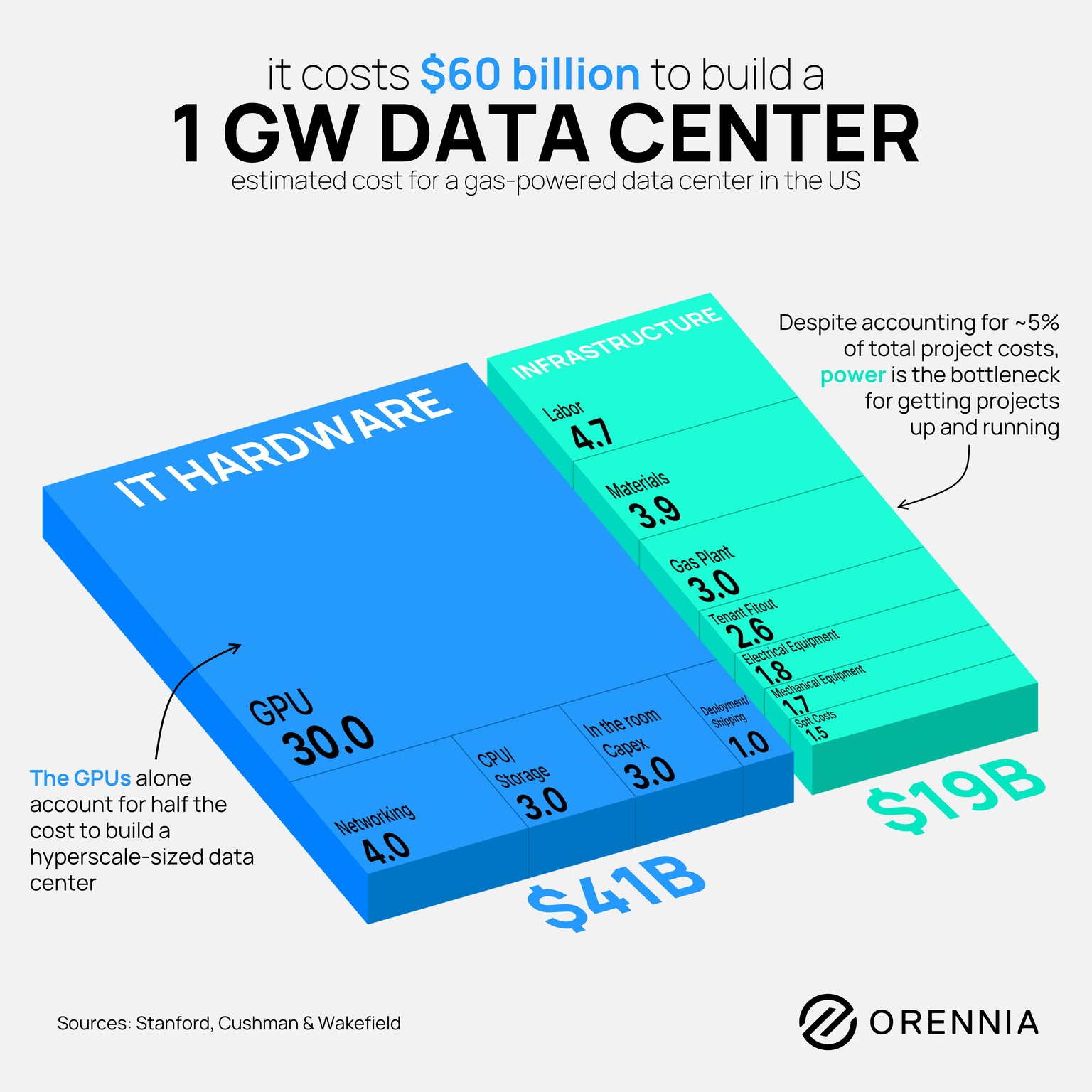
Economics of data centers explained by Chase Lochmiller, CEO of Crusoe at Stanford, highlights the total capital costs to build a full hyperscaler data center.
Since the launch of ChatGPT in late 2022, quarterly hyperscaler capex has grown by nearly 180%, reaching $142 billion in a single quarter. Training a frontier AI model requires hundreds of thousands of chips running flat-out for months. And serving those models to users, known as inference, requires just as much ongoing compute.
Why it costs $60 billion
A 1 GW gas-powered data center runs about $60 billion all-in. The split is roughly 70/30 between IT hardware and physical infrastructure.
The building, power plant, labour and fit-out run about $19 billion. Everything in the rack between the chips, the networking and the storagecosts $41 billion. The GPUs alone are estimated to account for half of all the capital costs to build a hyperscale data center.
It’s no wonder that Nvidia is a $5.4 billion company — every major frontier model is trained and primarily served using Nvidia chips. A single H100 GPU costs between $25,000 and $40,000. A standard 8-GPU server system runs $300,000 to $500,000 before you've touched power, cooling, or networking.
Power is the gating factor
Power is the scarce input in data center development, but the constraint is less about electricity generation and more about the physical equipment needed to connect to the grid.
Substation transformers now carry lead times exceeding 160 weeks, up from 24 to 30 months before 2020, because manufacturers simply have not kept pace with the surge in large-load requests from AI infrastructure buildouts.
Interconnection queues compound the problem, with wait times now in the multiple-year range for most regions. The result is that fully financed, fully permitted projects sit idle for years, waiting not for capital or construction crews, but for a single piece of high-voltage hardware.
Big picture
The US could add 75+ gigawatts of data centers by 2035 to support AI growth. At $60 billion per gigawatt, that would amount to $4.5 trillion worth of investment. And given the extra demand for turbines, transformers, chips and labor, the cost of building is only expected to go up.
+Bonus viewing: Economics of the AI Supercycle
Insights for an evolving energy landscape delivered to your inbox.