
Aaron Foyer
Director, Research
Should emergency clauses be kept for real emergencies?
Aaron Foyer
Director, Research
At what level of emergency should the government take control of the power grid?
This isn’t hypothetical. On the eve of the US entering World War II, Washington was forced to take control of parts of the grid to deal with the astronomical electricity needs of making aluminum.
In 1940, the production of both aluminum and magnesium to support the war effort consumed a staggering one-seventh of all power generated in the US and required government intervention to keep going. For context, no single US industry today consumes anywhere near that. You'd have to combine papermaking, oil refining, steelmaking, auto manufacturing, chemicals and data centers to get to the share that aluminum and magnesium demanded at that point.
Taking flight: Aluminum was the metal chosen for nearly all the 300,000 planes built during WWII; being a third of the weight of steel made it better for fuel efficiency and bomb loads.
In 1939, the US made 2,141 aircraft. The following year, it made 6,086. And in 1941, America churned out 26,277 planes, a 13-fold increase in just two years.
War needs were paramount, and it was the intense electrical needs of smelting aluminum that drove up power use.

The American B-17 Flying Fortress was used extensively in World War II
But as the war pressed on, so too did the pull on the American power grid. Between 1940 and 1945, US power consumption increased 60% while generating capacity grew just 25%.
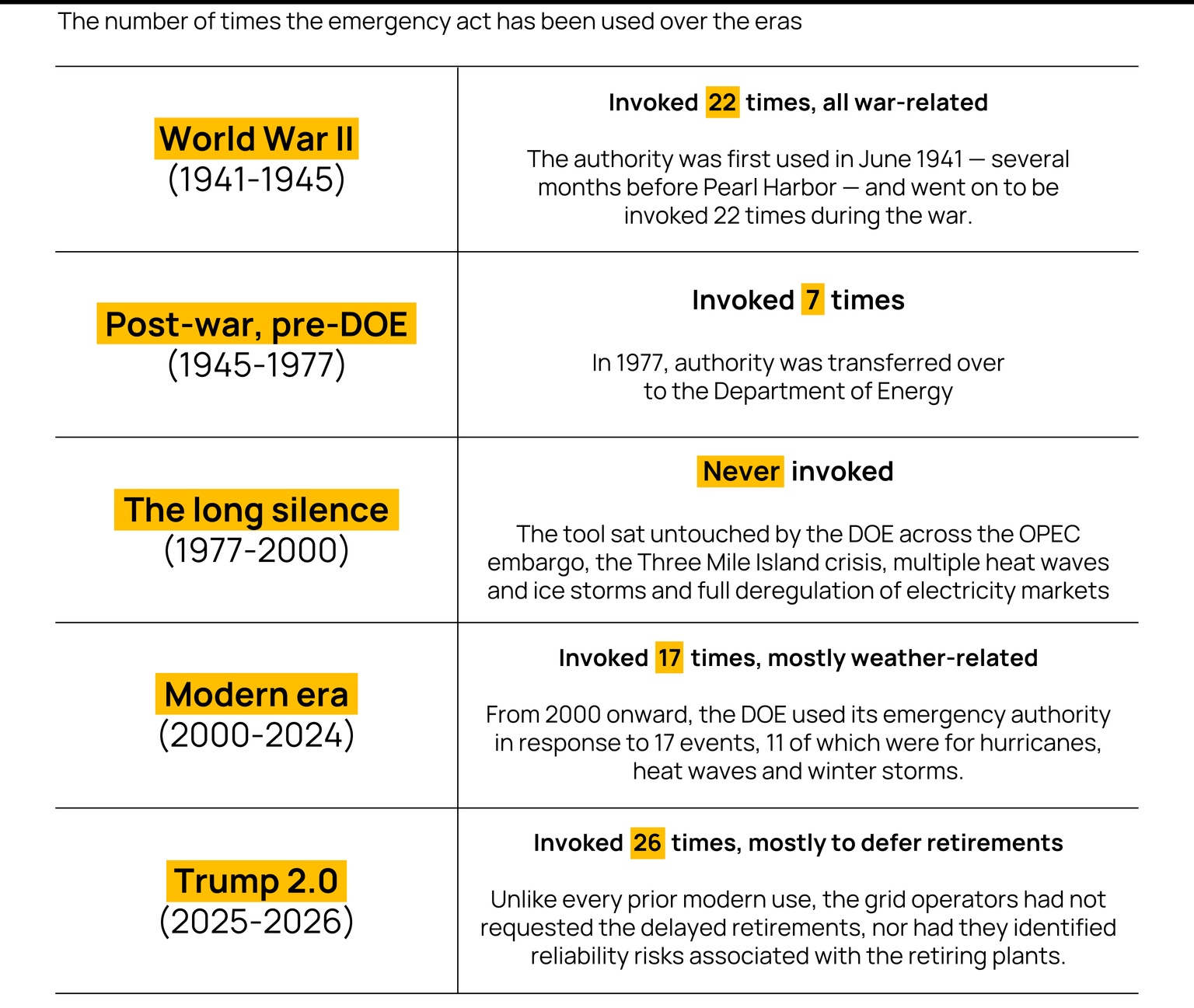
The grid strain from the war forced the government to invoke, for the first time, an emergency clause in the Federal Powers Act. The clause was specifically written five years earlier for wartime use, giving Washington a tool to control facilities on the grid in extraordinary times.
Rarely used, for good reason: Since its first use in 1941, Section 202c of the FPA has been used just a few dozen times to ensure reliability of the grid, mostly to deal with war-time demand or weather-related emergencies, such as hurricanes, heat waves or acute fuel supply shortages.
But the Department of Energy in the second Trump administration has taken a completely novel approach to the tool, using it as liberally as a snooze button on a Friday to force various coal-fired power plants to stay open.
And that’s not to say it’s not justified. If you were to step into the DOE’s office today, they’d probably say, “look, the data centers behind the race for AI are increasing demand for electricity at the fastest pace since the emergency clause was first used nearly a century ago. And at the same time, we’ve got more intermittent sources of power on the grid than any other time in history, with more being added every day. We are in an emergency and are compelled to act.”
Source: US Department of Energy
But the Trump administration has its critics, and many are wondering whether invoking emergency measures is necessary, especially as grid operators have yet to ask the government to intervene. As Minnesota Attorney General Keith Ellison put it: “It makes no sense for the federal government to force old, out-of-date, expensive, and polluting coal plants to continue operating far past when they were supposed to shut down."
So, do critics just have TDS and the DOE is fully justified in forcing the coal plants to remain open, or should the sanctity of emergency clauses be kept for real emergencies? Let’s fire up the boilers and find out.
The Federal Power Act was signed into law in 1935 by FDR as part of the New Deal-era overhaul of how America governed its electrical system.
Tucked into the FPA was a little provision called Section 202c, an emergency clause that gives the federal government authority to order power plants to keep running, or to force connections between grids, when the lights were about to go out.
The authority can be invoked during “the continuance of a war in which the United States is engaged” or by “a sudden increase in the demand for electric energy, or a shortage of electric energy, or of facilities for the generation or transmission of electric energy, or of fuel or water for generating facilities.”
A bit of a word salad, but in short, the trigger conditions for emergency power were deliberately written to be very narrow. But then came along a president with a very wide interpretation of emergency power.
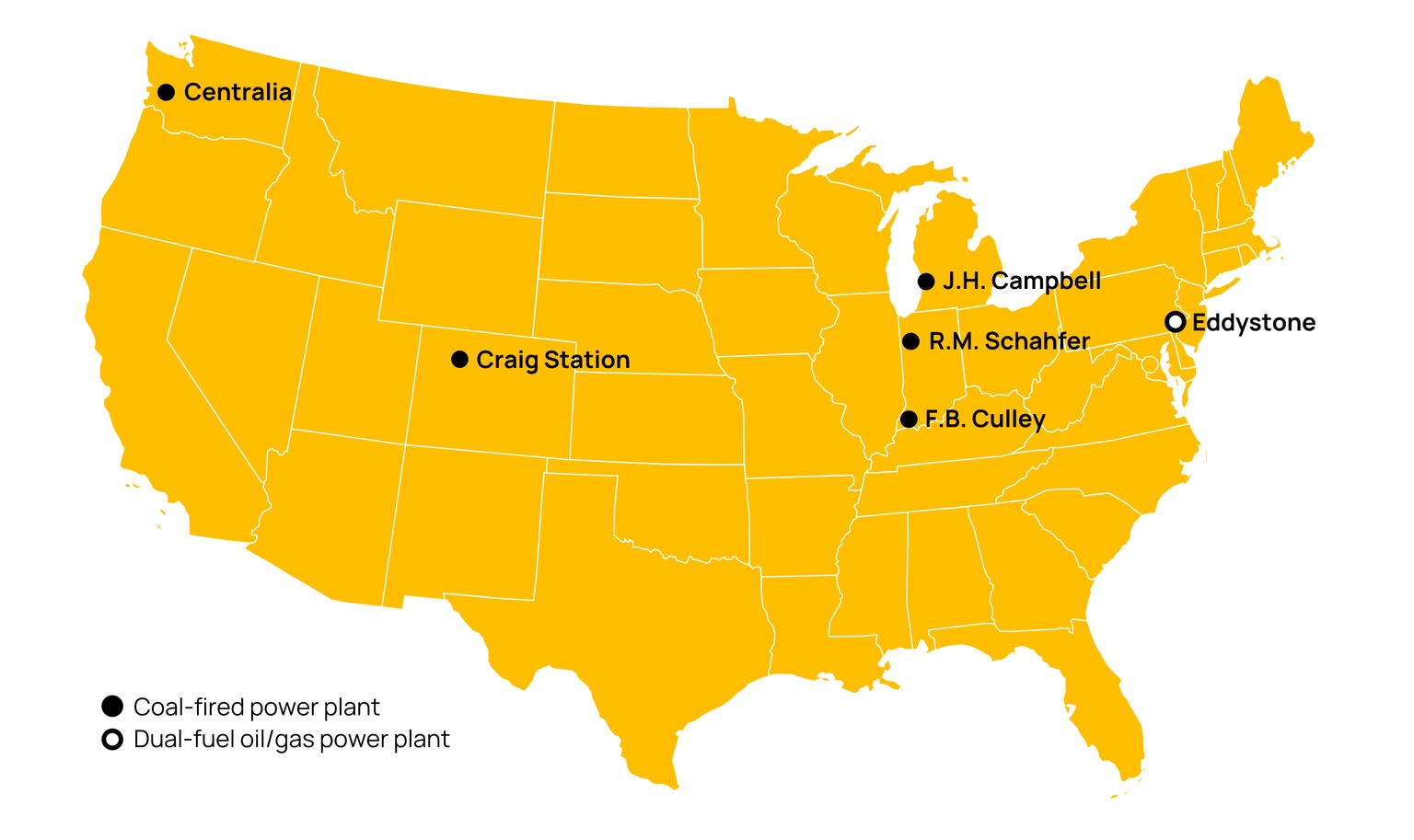
Trump’s first use: A year ago, nearly to the day, Secretary of Energy Chris Wright issued the first emergency order to keep the 1.42-gigawatt J.H. Campbell coal-fired power plant in Michigan operating, arguing "insufficiency of dispatchable capacity and anticipated demand during the summer months."
Less than a week later, on the last day before its planned retirement, the 760-megawatt Eddystone dual-fuel plant was also ordered to stay open by the DOE. All it really wanted was a nice sheet cake and to work on its short game.
Sources: The US Department of Energy, Every CRS Report
In total over the past year, six power plants have been ordered to stay open, five of them coal-fired.
The DOE regulations restrict the 202c clause from being a long-term solution, so regulations limit stay-open orders to 90 days. But there’s a loophole: there are no limits on the number of renewals that can be used on a plant.
The J.H. Campbell plant is already on its fourth 90-day renewal while the Centralia, Schafher, F.B. Culley and Craig Station plants are all on their third.
This is the key question: are these plants needed for grid reliability?
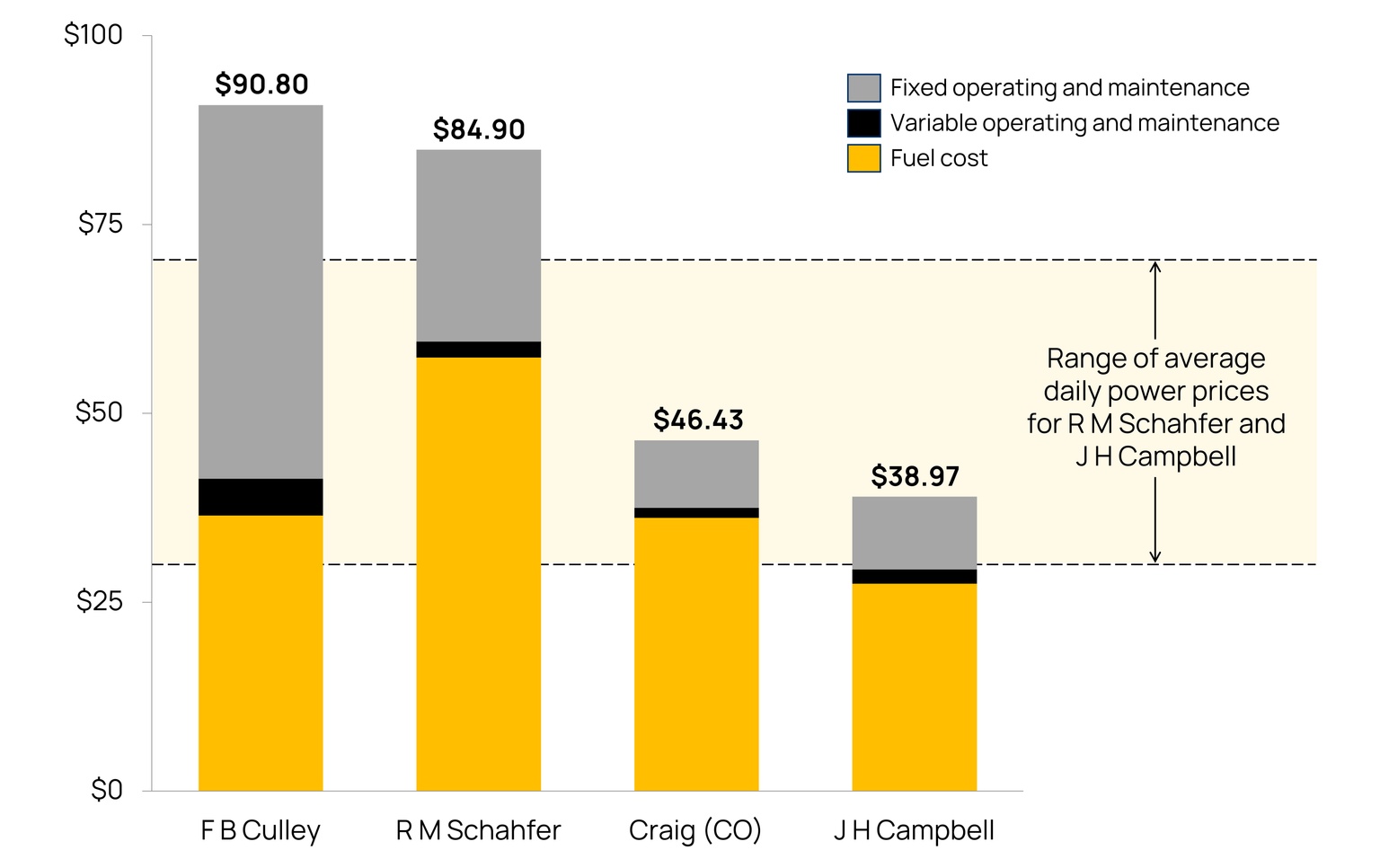
And before getting into that, it’s worth mentioning that these coal plants are not competitive anymore on their own merit. Coal power is expensive to generate, not because the fuel is costly, but because the plants are typically old, maintenance-heavy and are increasingly outcompeted by cheaper alternatives.
Source: US Energy Information Administration
The F.B. Culley and R.M. Schahfer power plants in Indiana can’t even cover their operating costs anymore for the typical power prices that projects receive in the region. There’s a reason they were handing their Looney Tunes ties down to their kids and browsing Zillow for a nice condo down in Sarasota.
But to the bigger question, are these plants needed for reliability? The grid operators certainly don’t think so.
The reliability story is empirically thin: The plants the administration has ordered to keep running are precisely the ones that grid operators, after years of formal study, had cleared for retirement.
The Midcontinent Independent System Operator approved the J.H. Campbell retirement in March 2022. PJM gave the thumbs up for Eddystone’s deactivation with a finding of “no reliability violations associated with the deactivation of this generator.” The Colorado Public Utilities Commission said the Craig Unit 1 “is not required for reliability or resource adequacy.” And Centralia’s closure was anchored in a 2011 state law and contractual settlement.
Little use: It would be one thing if the DOE’s orders were addressing a significant reliability issue, as Section 202c was designed to do, but they aren’t.
The Schahfer plant is half broken, with one of its two units offline and requiring $1 billion in repairs to fix. Even during Winter Storm Fern, when reliability was critical, it’s not believed the plant was needed. A post-op about the storm from the Sierra Club said, “while we are still reviewing data from operations during the storm, the Culley and Schahfer units were likely unnecessary.” The plant nonetheless costs consumers $174,000 per day to keep open.

Source: Orennia
As for Eddystone, it ran for a combined 124 hours over a 1,440-hour window, or just 4% of the time, according to the DOE’s own records.
The Centralia plant in Washington has essentially generated no electricity during its first emergency order period while accumulating nearly $20 million in fixed costs. So, ratepayers paid $20 million for a plant that never ran.
And Midwestern families are on the hook for $180 million so far to keep the J.H. Campbell plant open. Unfortunate for them, as Dan Scripps, chair of the Michigan Public Service Commission, put it: “There is no existing energy emergency in either Michigan or MISO.”
What makes all these orders unique is that they are the first time Section 202c has been issued sua sponte — without any request from the plant owner, the grid operator or the state regulator.
There’s something to be said about America’s willingness to let things fail.
The government could have come out and protected the antiquated yellow taxi medallion system during the period of mobile disruption, but it didn’t and instead we got Uber, Lyft and Waymo.
Telecommunications is one of the most heavily regulated industries on the planet, and the government could have easily worked to protect its large land infrastructure investments. But regulators didn’t mandate that people keep paying for landlines and now eight in 10 adults in the US are wireless-only users.
Beyond the $3 billion per year that Grid Strategies estimates it would cost to extend this policy to all retiring fossil fuel plants, there are significant opportunity costs. Like Uber, Waymo and mobile phones, there is a new suite of technologies disrupting the status quo in the power industry.
The government stepping in to protect aging and sclerotic industries only serves to kill the price signal of modernizing a grid in desperate need of modernizing.
Bottom line: The first time Washington’s emergency clause was pulled from the drawer, it was used to help build an arsenal of planes to fight a world war. Now it's being used to run up a $20 million bill to keep the lights on in a plant the grid doesn't need.
Insights for an evolving energy landscape delivered to your inbox.