
Aaron Foyer
Director, Research
The first American city running dry
Aaron Foyer
Director, Research
What happens when a major industrial city enters a prolonged drought and there’s not enough water to meet demand? Who gets their taps shut off first?
The residents of Cape Town nearly found out in late 2017, as the city experienced a 1-in-400-year drought and approached something city officials called “Day Zero.”
The beautiful South African coastal city that sits at the convergence of the Atlantic and Indian Oceans relies heavily on six surface reservoirs for water, the Theewaterskloof Dam being the largest. Starting around 2015, three consecutive winters delivered far-below-average rainfall, depleting reservoirs.
Had Day Zero been hit, the city would have shut off municipal water networks for households and businesses, and left only critical services — like hospitals, some schools and key economic hubs — connected.
The city was just weeks away from the point it would have forced residents to collect a daily water ration from about 200 distribution points around the city, guarded by police and the army. Lines were expected to stretch for hours.
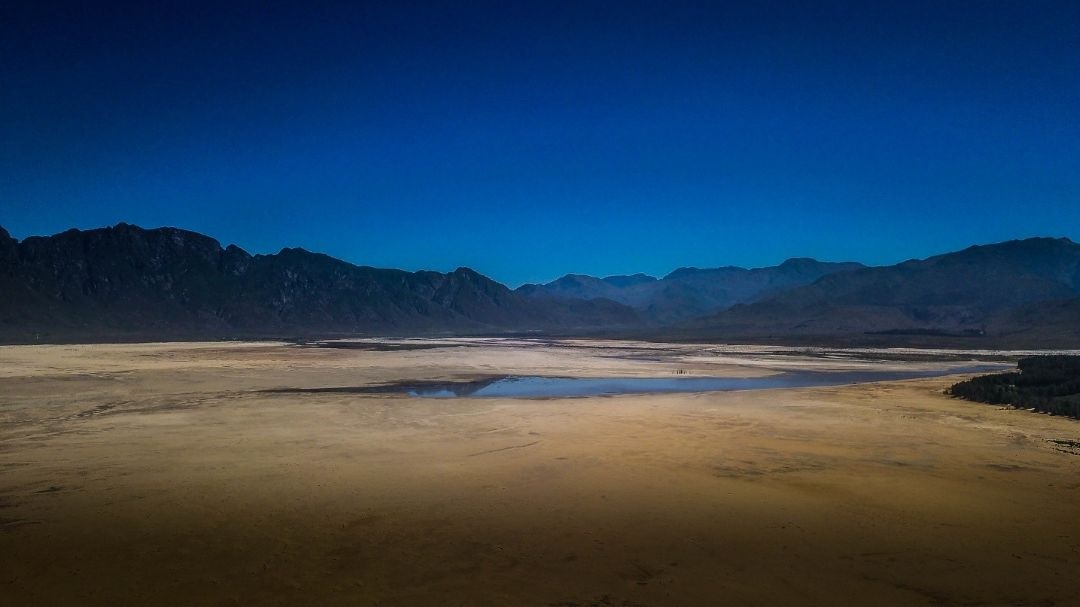
The Theewaterskloof Dam, the largest reservoir in the Western Cape, South Africa, during the 2017 drought // Flickr (Ballacorkish)
As Day Zero approached, residents faced strict water limits: households could use only 13 gallons of water per day, just 5% of the average daily water use of an average American household today. And the group that suffered most was the group that always suffers most: the poor. Rural communities and informal settlements relying on communal water taps required daily queueing during the crisis.
Luckily for Cape Town, the rain eventually showed up, refilling surrounding reservoirs and ending the drought before daily rations took hold. But as populations and industries continue to grow around the world, another water crisis is not just possible, it’s inevitable.
The first American city running dry: The US is on the verge of its own Cape Town crisis. And of all the places, it’s in arguably the most important industrial and energy hub in the country, highly reliant on water for the industries at the heart of American energy independence.
Corpus Cristi in Texas, the nation’s top crude oil export terminal and cornerstone of America’s petrochemical corridor, is facing the most acute water crisis of any major US city in modern history.
A five-year drought has drained its two primary reservoirs, and city officials have warned that a Level 1 Water Emergency that would force some industrial facilities to shutter could be declared as early as December.
So, what happens when the reservoirs dry up in a water-ravenous energy and chemicals hub in America? Let’s turn off the taps and find out.
For a mid-sized coastal city, Corpus Christi punches well above its weight.
The city is the largest crude oil exporter in the US, shipping ~2.5 million barrels per day. That means it accounts for more than half of all US crude oil exports. Being located near both the Eagle Ford Shale and Permian Basin, the city’s port is a natural strategic exit point for domestic oil.
It’s also home to a dense corridor of petrochemical facilities, steel mills and liquefied natural gas export terminals. The Port of Corpus Christi is the third-largest American port by tonnage, exporting $76.4 billion last year alone.
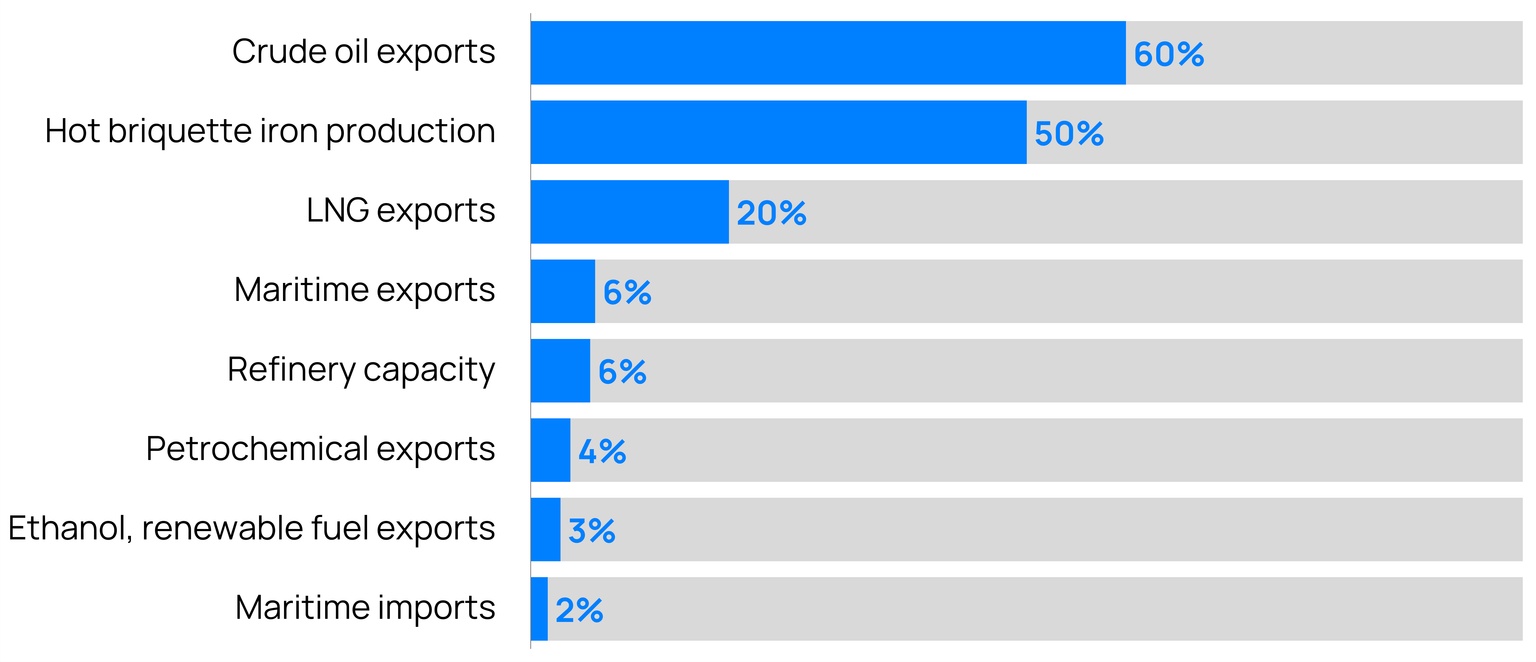
Data source: Corpus Christi Regional Economic Development Corporation
The 12,000 energy and petrochemical workers in the city get paid three times the local median income and the port’s broader statewide economic footprint supports an estimated 800,000 jobs.
In short, it’s a vital American economic hub. There’s more wealth and goods that sail out from Corpus Christi every day than several countries produce in a year. And water is critical for that.
Running on empty: In similar-sized cities in Texas, an already industry-heavy state, industry typically uses 38% of the local water supply. In Corpus Christi, it’s at least 58%, a share that is expected to grow as many of the industries and facilities are expanding.
As the Federal Reserve Bank of Dallas put it: “Texas’ strong economic growth depends on a steady supply of fresh water.”
The city’s water crisis did not happen overnight.
Rainfall in the region has grown increasingly volatile in recent years, swinging from extreme droughts to flash flooding, which helps saturate the soil but does nothing to refill reservoirs.
Volumes at the Choke Canyon Reservoir, the city’s largest supply of water, fell by 60% between early 2023 and today. And Lake Corpus Christi, the second-most important supply source, has fallen by nearly 70%.
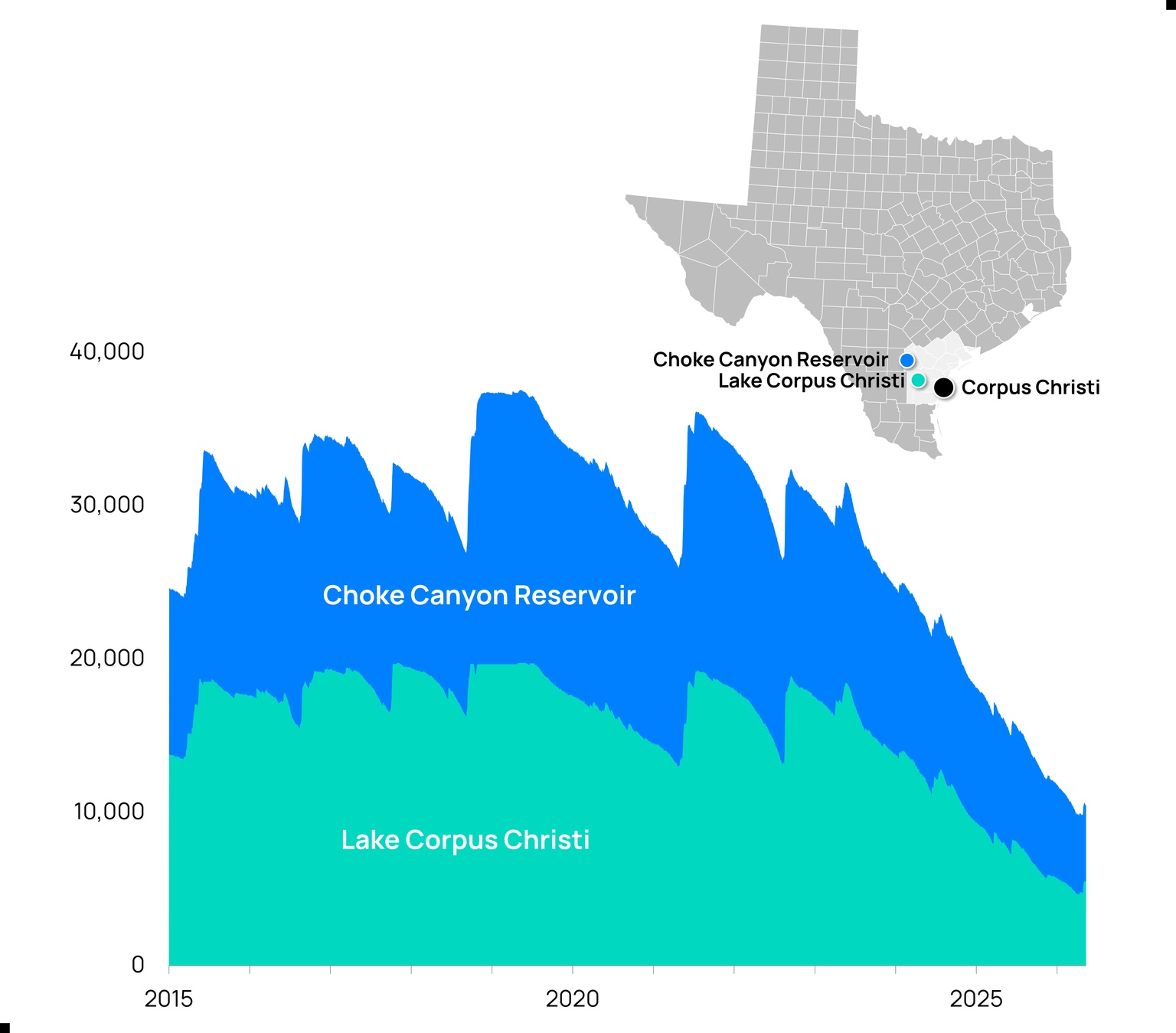
Data source: Water Data for Texas
The drought is not limited to Corpus Christi, or even Texas. The broader southern plains have experienced drought conditions for six consecutive years.
As of early April, 89% of Texas and 99% of Oklahoma are in drought, according to the US Drought Monitor. The two main reservoirs sit at a combined 7.8% of their total capacity.
Everything is poised come to a head later this year, when Corpus Christi is expected to enter a Level 1 water emergency, meaning the city’s supply will be just 180 days away from not being able to meet demand. By early 2027, water demand in the industrial city could outstrip supply by as much as 60%.
As one water consultant put it, “the only thing they can do involves a gavel because at this point, they can't do anything with a shovel.”
When that happens, who gets cut off? Families or some of the most important industries in America?
Last month, the City Council voted 7-2 in favor of an initial curtailment plan that would see a mandatory 25% reduction for industrial and wholesale customers.
But here’s the schtick: the curtailment plan has all the enforcement strength of a “clean out the fridge by Friday” sign. Freedom-loving, business friendly Texas has few mechanisms to deal with anyone who breaks the water rules outlined by the city.
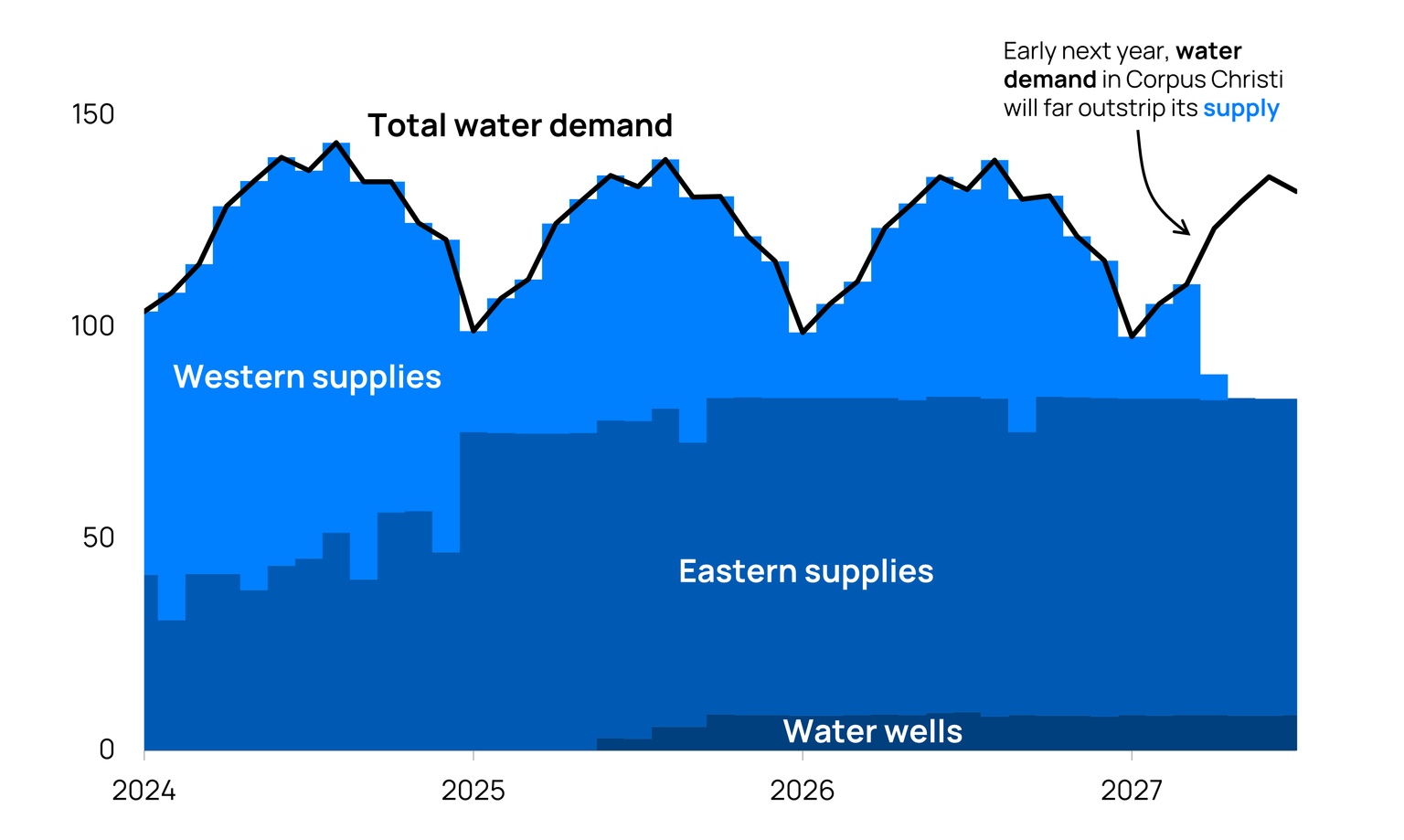
Data source: Corpus Christi Water
Paper cuts: For the residents,an L1 emergency means each customer would be asked to limit their use to 6,000 gallons per month — roughly 30% of residents currently exceed this. But the curtailment plan clearly highlights that “residential customers will not be subject to violations, penalties, or enforcement actions for exceeding their water baseline or allocation.”
In other words, it’s a voluntary ask from the city dressed up as a limit. The cuts will have to come from the industrial side.
Industry cuts: Even here there are problems. Years ago, the 10 largest industrial water consumers in Corpus Christi signed up for a voluntary program to pay an extra 31 cents per gallon, which bought them permanent exemption from drought surcharges during a Level 1 water emergency, something the city confirmed remains in effect.
Like everyone else, those customers would still be required to cut 25% of their water, but the only enforcement tool is surcharges, which they are exempt from. Required on paper, but not compellable in practice.
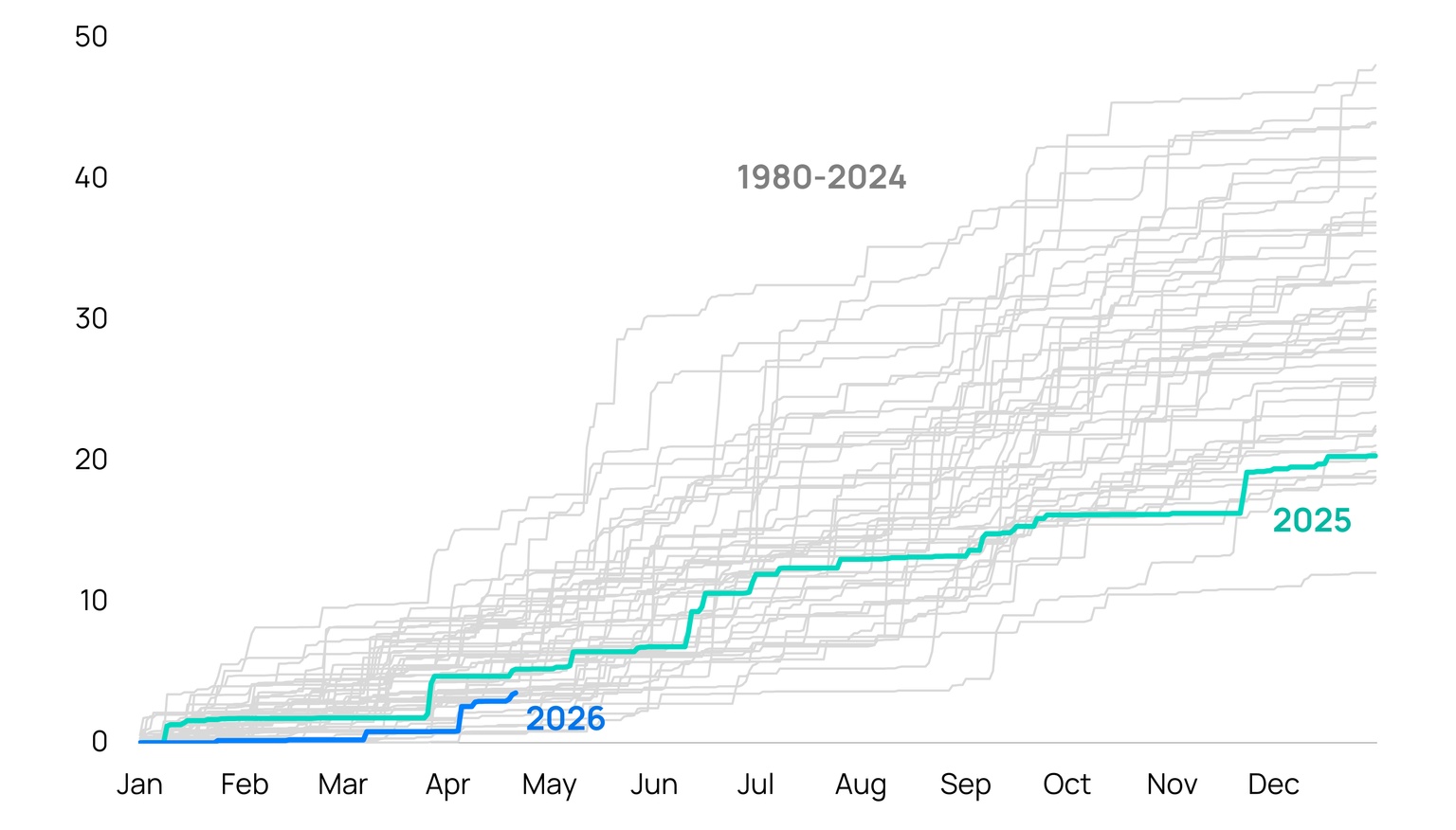
Data source: US National Oceanic and Atmospheric Administration
Refineries and chemical plants around Corpus Christi are urgently drilling wells hoping to source their own water to avoid a ramp down. ExxonMobil has so far been unsuccessful in drilling water wells, striking only salty water to date. Valero and Flint Hills Resources have agreed to use reclaimed wastewater at their facilities, in place of drinking-grade water.
But industry in Corpus Christi faces real challenges at the back end of this year if companies can’t cut and rains don’t show. The potential fiasco was likely avoidable, with an on-again, off-again desalination plant that has been in the works for more than a decade. But the city built itself into a water crisis by aggressively courting industrial facilities before securing drought-proof sources to supply them.
For a city that injected more than $113 billion into the Texas state economy in 2024, a water shortage will be felt by more than those hoping for a good year with their begonias.
You don’t hear the term ESG used very often anymore. Environmental, social and governance frameworks followed the sourdough hype-cycle and largely deflated like a neglected fermented starter after the pandemic.
And there is merit to the neglect: People were treating ESG company scores like credit ratings, and they simply weren’t. Far from picking winners and losers in various sectors, the ratings effectively whittled investments down to a pile of tech stocks.
But Corpus Christi is a prime example of why understanding environmental risks is quantifying business risks. You could go as far as to say quantifying national energy security risks.
Texas was the first state to pass an anti-ESG law (also the first to have one ruled unconstitutional by a federal court) and is now on the verge of being ground zero for what could be the most acute water crisis of any major US city in modern history.
Bottom line: Cape Town avoided its own Day Zero with some luck from the rain gods. Corpus Christi is still looking skyward, with a $113-billion economy and America’s crude exports hanging in the balance.
Insights for an evolving energy landscape delivered to your inbox.