
Aaron Foyer
Director, Research
Is AI driving electricity prices up?
Aaron Foyer
Director, Research
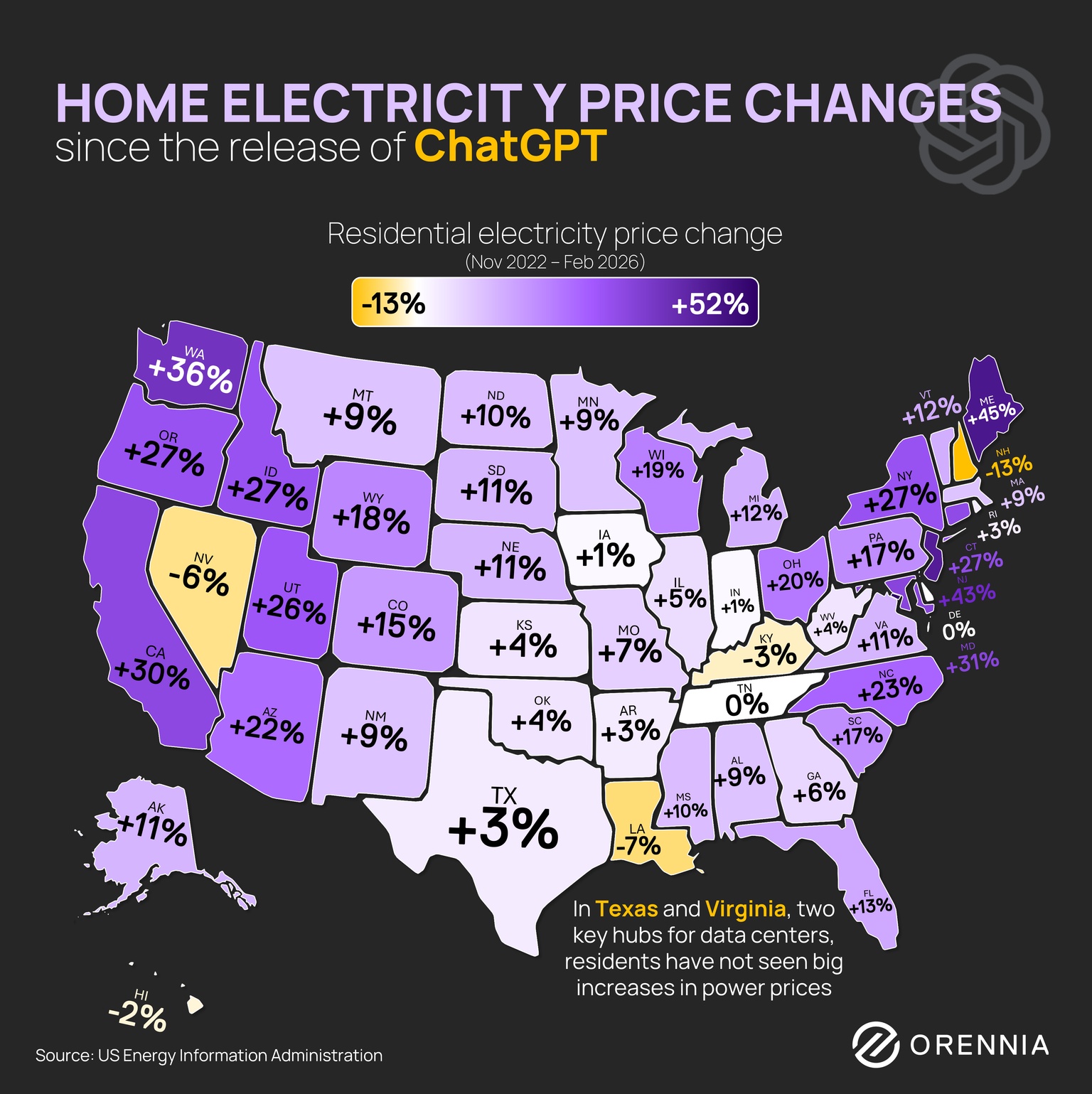
ChatGPT launched in November 2022. Since then, the average American's electricity bill has climbed roughly 13%. But that national average obscure a story that is almost entirely regional and the map above, made using data from the US Energy Information Administration, makes that gap visible.
The grid is local: New England is the clearest example. The region is heavily dependent on natural gas for power generation but faces some of the most constrained pipeline capacity in the country, leaving it exposed to fuel price shocks in a way that pipeline-rich interior states are not. When supply tightens, like during the 2022 energy crisis, and there's no alternative route in, prices spike hard and stay elevated. Many states in New England have rising 20-45% over the past few years.
Why are electricity prices higher in California than in Texas? The Pacific Coast faces a different version of the same problem. Wildfire damages and the expense of wildfire mitigation, including putting power lines underground and vegetation management, have substantially increased costs in western states. California saw electricity prices rise more than 6 cents per kWh in inflation-adjusted terms between 2019 and 2024, a major increase compared to much of the Northeast, which saw mild to moderate price increases over the same period.
Both the northeast and northwest, which import hydropower from Canada, have faced drought-driven shortages, contributing to higher prices.
No impact from data centers? The two key regions with the most data center growth — Texas and Virginia — have seen less impact on power prices… yet. While these two regions are seeing unprecedented growth in data center development, most have yet to come online and start impacting power markets.
The bottom line: From November 2022 through early 2026, prices have changed across every state, but AI is not (yet) the culprit. Electricity price changes are too complicated to blame on any single factor, with location, fuel mix, infrastructure age, pipeline access and regulatory structure all interacting to drive power prices.

Insights for an evolving energy landscape delivered to your inbox.