
Aaron Foyer
Director, Research
Is the cost of AI worth it?
Aaron Foyer
Director, Research
Stop!”
The TikToker @typical_redhead_ laughed as the drive-thru McDonald’s digital screen showed more than 1,900 chicken nuggets in her order.
Had there been an employee at the other end of the conversation, the $201 mistake could have been quickly fixed. But there was no employee, only a chat bot, serving as part of McDonald’s push to incorporate AI into its services.
Hardly alone, @themadivlog tried to order water and ice cream from another McDonald’s AI kiosk, but was instead offered ketchup packages and caramel. And @That_usa_guy_ saw his Mountain Dew order be perpetually swapped for a Medium Coke by the fast-food chain’s lane bot.
McDonald’s AI bot loves chicken nuggets // @typical_redhead_
McDonald’s foray into AI was eventually canceled as the results — and public mockery — just couldn’t justify the costs. And Mickey D’s is just one part of the broader corporate world that is collectively starting to wonder the same thing: is the cost of AI worth it?
Earlier this month, an executive at NVIDIA told Axios that the expense was “far beyond the cost of employees.” Microsoft echoed pretty much the same sentiment last month.
Amazon reportedly had a push for its workers to leverage AI as much as possible, going as far as having an internal system that ranked employees based on their AI use, something that was jokingly referred to as “tokenmaxxing.” But the tech company reversed course after it turned out to also be costmaxxing. Finance mogging the engineers.
The contradiction here is easy to see: The companies that are the most active in pushing the broader adoption of AI are the ones retreating from using it.
And it’s not like they aren’t eating their own cooking. The five hyperscalers — Alphabet, Amazon, Meta, Microsoft and Oracle — spent a combined $148 billion last quarter, largely building out data centers to support AI. The latest models cost hundreds of millions of dollars, just to train and before customers start to use them. And the companies behind them are expected to invest more than $700 billion combined just this year, roughly the GDP of Argentina.
Source: Epoch AI
There is little indication from the companies of a lack of demand. Earlier this year, Amazon CEO Andy Jassy told investors: “We are monetizing capacity as fast as we can install it."
Therein lies the puzzle that everyone has been trying to figure out: AI is starting to get expensive, but will the benefits outweigh its lofty costs? Whether companies will spend money incorporating AI into their businesses will ultimately come down to one thing: tokenomics.
So, what are the economics of AI and will it make or break companies? Let’s digmaxx in and find out.
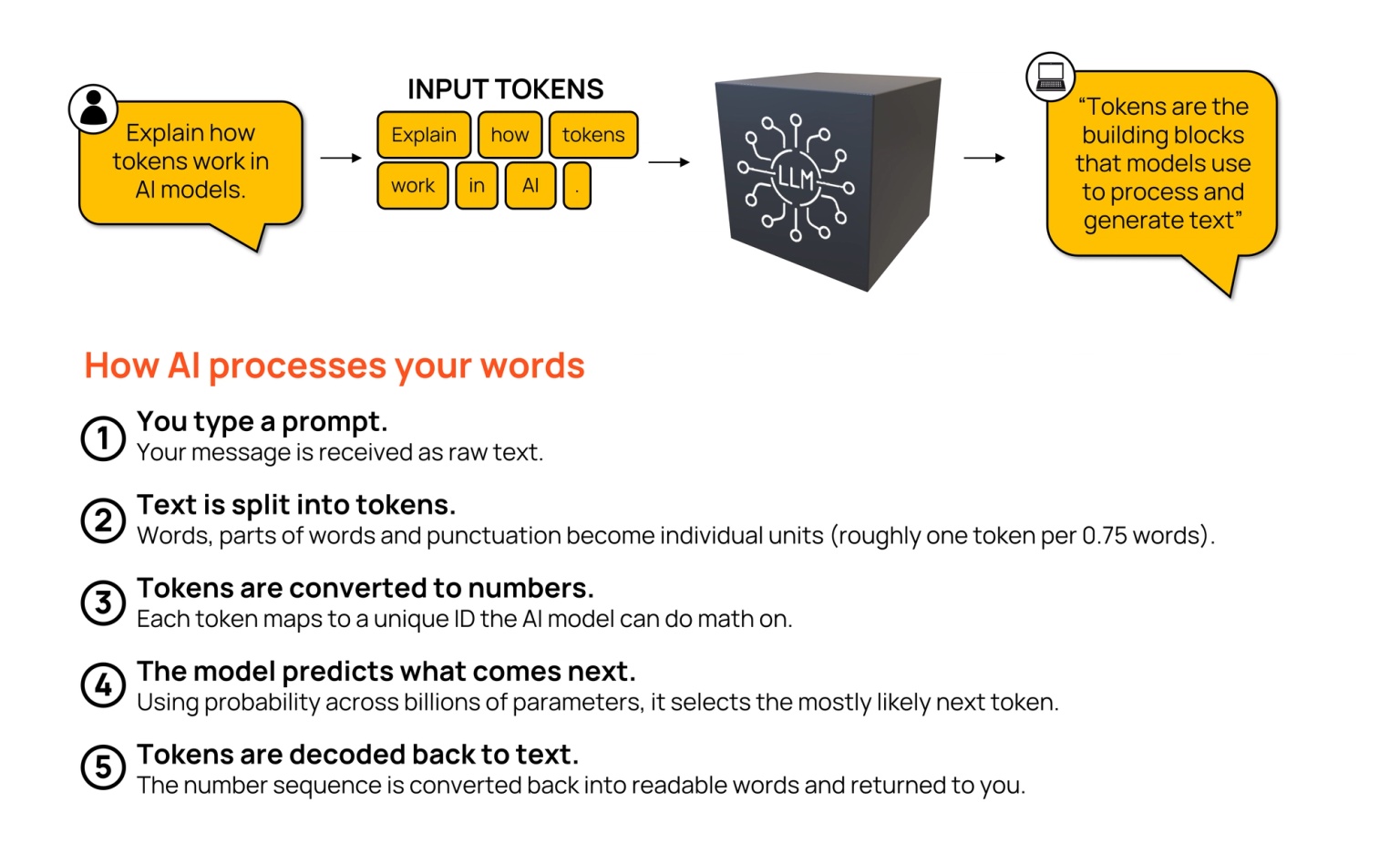
The building block of artificial intelligence is the token.
Not quite a letter, not quite a word, a token represents frequently occurring chunks of characters. Short words like “this”, “is” and “of” are usually one token. Larger words like “electrochemical” get split into “electro”, “chem” and “ical” tokens, to help keep compute costs down.
The process: The magic of large language models like Claude and ChatGPT is they take text, break it down to individual tokens and run statistics on the tokens to return a useful answer.
When you ask a chatbot, “She used a period at the end of her text — is she mad at me?”, it doesn’t Google the answer. It draws on patterns absorbed from billions of pages of human writing — Reddit threads about relationship advice, psychology and communication pieces about communication norms, texting etiquette articles — and produces the most statistically relevant answer.
Think of it less like a search engine and more like a well-read friend who has consumed the entire internet and can synthesize it on demand.
The good news for consumers is that AI tokens are getting much cheaper. Epoch AI tracked the cost of tokens for various models over time and found the rate that token prices are falling is astounding.
For models like GPT-3.5 that are strong on general knowledge, the San Francisco-based research institution found its cost-to-performance metric is improving 9x per year, meaning if some inquiry cost one dollar last year, it cost just 11 cents to do the same task this year.
And for the more sophisticated models, like GPT-4o that does Ph.D.-level science questions well, costs are dropping even faster — 900X per year. That one-dollar inquiry cost one tenth of one cent the following year.
In other words, the efficiency of AI tokens is improving faster than Moore’s law — the number of transistors on integrated circuits boards. That jibes with Goldman Sachs’ findings that token prices are falling 60 to 70% per year, faster than the 50% improvement in Moore’s Law.
Source: Epoch AI
All of that is phenomenal news for AI’s future: Reed Hastings launched Netflix in the late 1990s as a DVD mailing service in order to bide time for streaming video to emerge, which Moore’s Law made inevitable. There are unquestionably world-altering companies out there just waiting for tokens to get cheaper.
But back to the problem at hand: despite token costs plummeting, corporate AI bills are going up. Why?
And you can mostly blame AI agents.
In the quaint old era of simple AI chatbots with one-off exchanges, a single prompt and a single response would require roughly 1,700 tokens.
But now users can task AI agents with projects that can take humans hours and involve searching dozens of large documents and cross-referencing. That’s a lot of token use. Asking an AI agent to dig into a competitor before a meeting, including the last four quarterly reports, earning transcripts and scanning relevant news over the past month can burn through 500,000 tokens.
Alphabet CEO Sundar Pachai explained token use growth frankly at the company’s annual developer conference in May: Google processed 9.7 trillion tokens per month two years ago, 480 trillion in May 2025 and 3.2 quadrillion in May 2026 — a 7x jump in a single year.
Source: Exponential View
According to analysis done by Exponential View, the quarterly use of AI tokens has increased 12x over the past year. Just from the last quarter of last year to the first quarter of this year, token use has more than doubled.
As Orennia Senior Associate for Data Centers Cam Greenfield put it: “What happens when two exponential trends meet? There’s both exponential token consumption and exponential token cost reduction. If either of them is slightly out of balance, it changes the supply-demand dynamic entirely."
At the heart of the problem, there are a few different trends at work.
First, AI firms had been subsidizing use to incentivize adoption. SemiAnalysis found a subscriber paying $200 a month to Anthropic could burn through $8,000 worth of tokens. For ChatGPT, token use could be closer to $14,000. That’s obviously unsustainable, and the AI firms are paring back their subsidization, causing users to now frequently reach a point during the day when their access is cut off for several hours. According to McKinsey, an increasing number of corporate deals being signed by companies are pay-as-you-go, rather than a flat-fee subscription.
Second and related, many users are using models that are more powerful than they need. Most AI tools now offer a menu of models, instead of just one. Claude alone offers Haiku, Sonnet, Opus and, if you live the United States, Fable. Few consumers understand the trade-offs between speed, cost and capability of the different models. Writing a rap about your dog Gerald doesn’t need a 500,000-token agentic AI run, but that will burn through your daily budget mighty quick.
And third, and this might come as a shock, AI is just not as good as humans at many tasks, especially those that involve taste. As the Financial Times recently reported, since the release of Agentic AI in early 2025, the number of new apps being released has gone through the roof, but ratings have plummeted.
Source: Writing Code vs. Shipping Code: Productivity Effects Across Generations of AI Coding Tools (Demirer et al., 2026)
We’re now witnessing a natural part of the AI adoption cycle: users and businesses are weighing the true costs with the observed benefits.
There is no doubt that incredible revenue is being made by AI firms. Exponential View found AI is scaling revenues three times faster than the internet, mobile apps or the cloud ever did.
And losing money in the early days is just the name of the game in Silicon Valley. In an interview in 2000 with BBC Newsnight, 36-year-old Jeff Bezos bragged that Amazon was a “famously unprofitable company.” The founder was fine operating Amazon.com at a loss because it was acquiring valuable market share and driving customer loyalty. Now it’s a $2.5 trillion company.
But in 1999, Amazon lost just $719 million. Compare that with OpenAI, which had an operating loss of $20.9 billion last year.
Anthropic CEO Dario Amodei explains the complicated economics within the AI startup: “If you consider each model to be a company, the model that was trained in 2023 was profitable. You paid $100 million, and then it made $200 million of revenue. What’s going on is that while you’re reaping the benefits from one company, you’re founding another company that’s much more expensive and requires much more upfront R&D investment.”
In other words, the significant growth for AI will end when the cost to build the latest and greatest model, and the subsequent token used to run it, exceeds what people are getting out of it.
So, are we there yet? If McDonald’s AI drive-thrus keep posting $210 worth of Chicken McNuggets in their orders, we might be getting close.
Insights for an evolving energy landscape delivered to your inbox.