
Aaron Foyer
Director, Research
Aaron Foyer
Director, Research
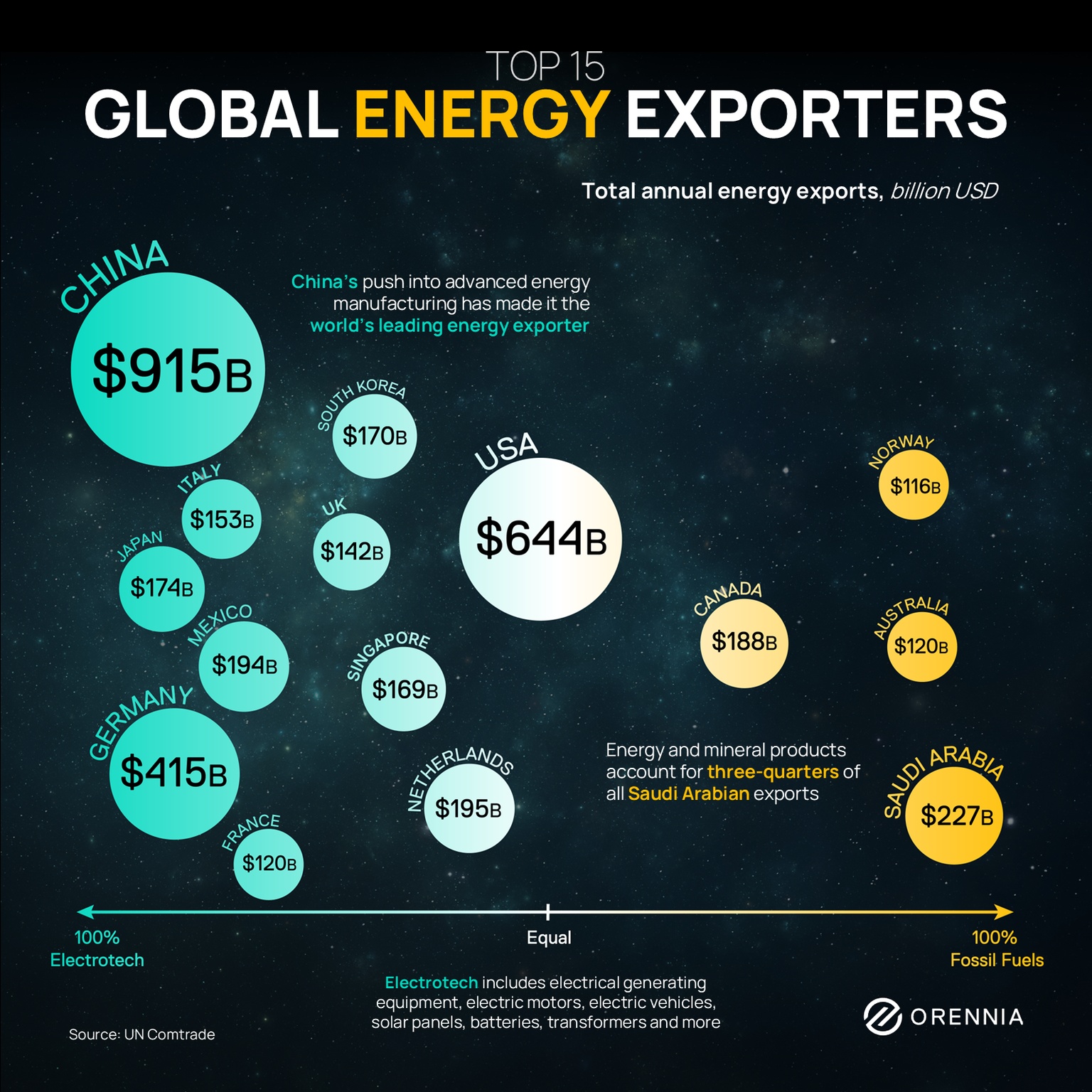
For most of the last century, "energy exporter" meant being a country that sat on oil or gas reserves. But a new category of energy exporter has emerged that sells the hardware for electrification: solar panels, batteries, electric motors, transformers and grid components. Analysts group these under the label electrotech.
Of the 15 largest energy exporting countries in the world, the majority of them now export equipment for electrification.
China saw this coming
China's position as the world's largest energy exporter, at nearly a trillion dollars in annual exports, doesn't reflect the discovery of new oil fields, but a two-decade industrial strategy.
By establishing first-mover advantage through aggressive capacity expansion backed by subsidies, tax incentives and the systematic build-out of full supply chain capabilities, China came to dominate the production of manufactured goods needed for the energy transition.
The government's "new three" export industries, EVs, solar panels, and batteries, weren't accidents, but targets, written into five-year plans and national technology programs going back to the mid-2000s.
The shifting cost structure: Unlike oil and gas, which require ongoing fuel purchases and so revenues are continuous for exporters, clean energy equipment is overwhelmingly upfront. Once a solar farm or battery storage facility is built, the marginal cost of operation is close to zero. The fuel, sunlight or wind, costs nothing.
Much less reliant on geology, being the global leader in energy exports in an electrified world depends almost entirely on being the cheapest.
Where is energy investment going?
Global energy investment in 2026 will likely hit $3.4 trillion, with clean energy accounting for $2.2 trillion of that total. Fossil fuel investment, across oil, gas, and coal, is expected at around $1.2 trillion, according to the International Energy Agency.
Insights for an evolving energy landscape delivered to your inbox.