
Aaron Foyer
Director, Research
Aaron Foyer
Director, Research
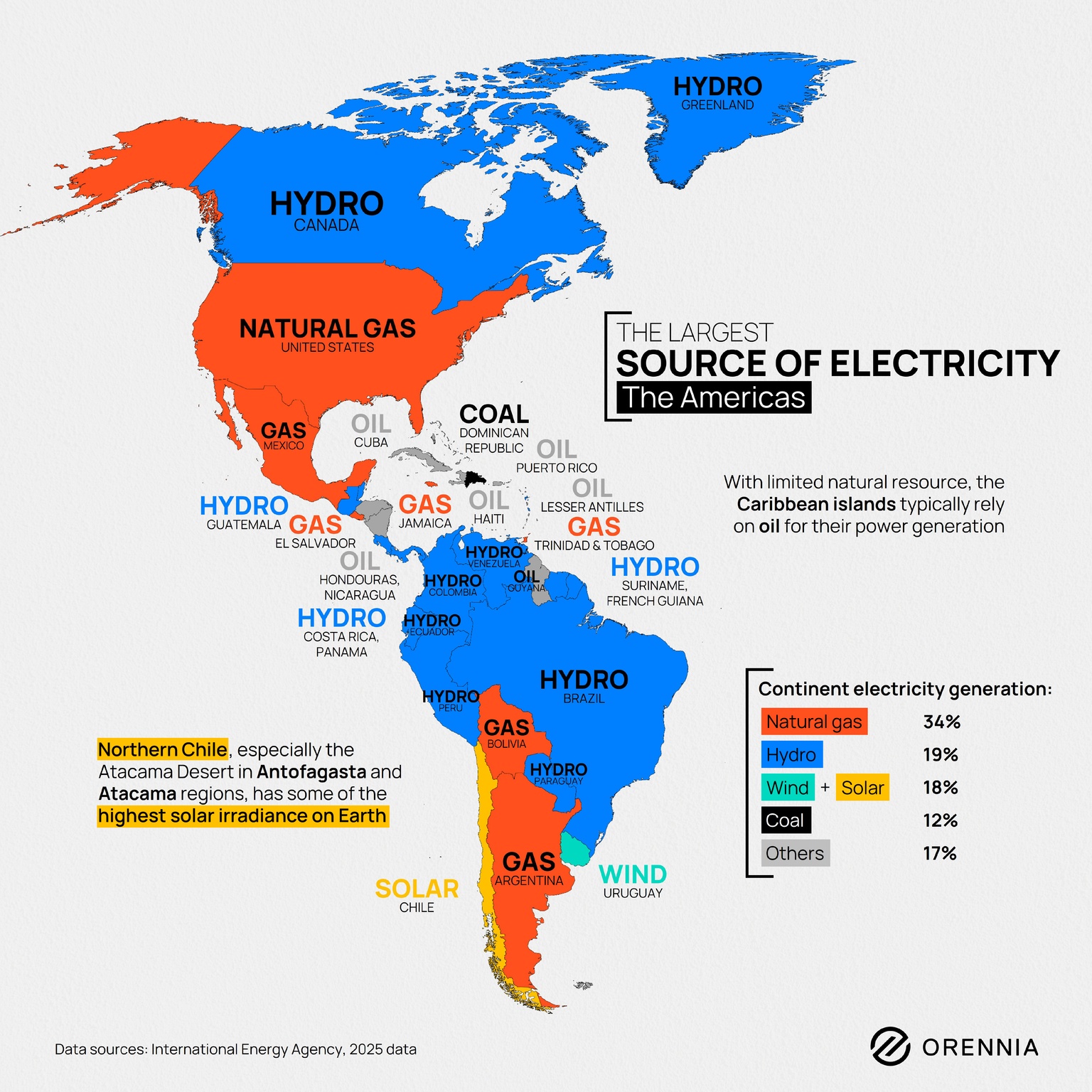
Natural gas and hydro together power roughly half the Western Hemisphere, but the two sources rarely overlap on a border.
Natural gas v. hydro
For natural gas, the US and Mexico form the largest bloc in the hemisphere, with smaller footholds in Central America and parts of the Southern Cone.
The United States relies primarily on natural gas for its electricity, a story anchored on shale. The Marcellus, Permian and Haynesville plays crashed domestic gas prices relative to global benchmarks over the past decade, turning gas plants into the default marginal generator for utilities and providing dispatchability against wind and solar. By contrast for Mexico, most of its gas arrives by pipeline from the US, a function of underinvestment in domestic upstream production rather than resource abundance.
But for areas that have the right geography, hydro is dominant, especially in Canada and Brazil.
Canada’s largest electricity source is hydro. The country’s river systems, concentrated in British Columbia, Manitoba and Quebec, give the country access to some of the cheapest and most reliable baseload power anywhere. Brazil's Amazon and Paraná basin dams operate at even greater scale, historically supplying 60 to 70 percent of national generation. That scale comes with a tradeoff: drought years have shown how exposed hydro-dependent grids are to hydrology risk when reservoirs run low.
Why the Caribbean runs on oil
Island grids across the Caribbean rely on oil because the alternative, natural gas infrastructure, requires investments in pipelines, LNG import terminals and storage facilities, that small, isolated demand centers can't justify.

Oil arrives by tanker to existing ports, making it the path of least resistance for decades of power planning. It comes with a cost, though: fuel oil and diesel generation make Caribbean electricity some of the most expensive in the hemisphere, with power bills directly exposed to swings in Brent and refined product prices.
Looking ahead: Although natural gas is currently the dominant source of electricity across the Americas, wind and solar already account for 18% of total generation, a share that’s growing fast.
Chile stands out for solar power. High solar irradiance in the Atacama Desert helps drive the renewable source’s adoption in the country.
Insights for an evolving energy landscape delivered to your inbox.