
Aaron Foyer
Director, Research
Aaron Foyer
Director, Research
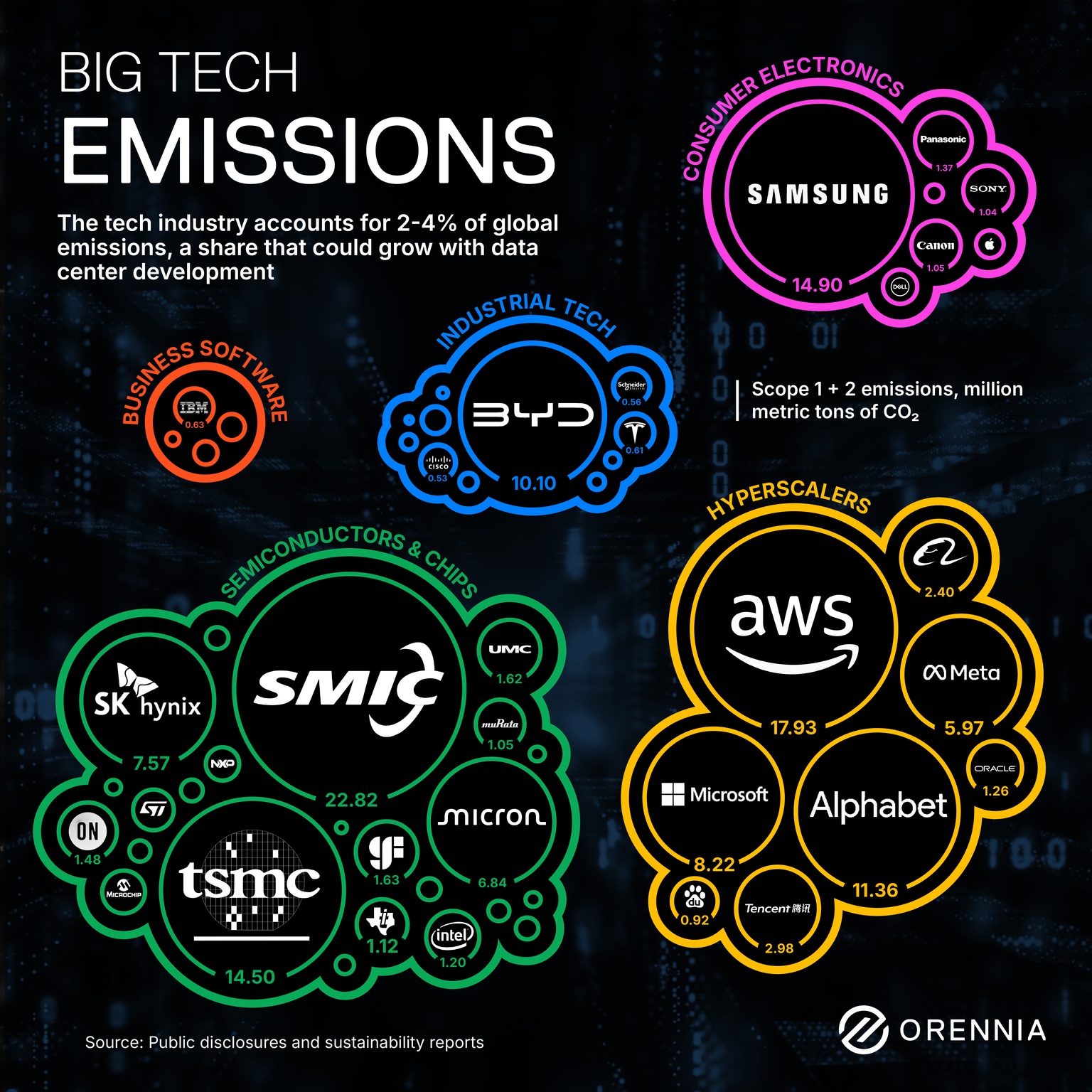
How much do big tech companies contribute to global emissions?
The tech industry accounts for 2 to 4% of global greenhouse gas emissions, a share that looks poised to grow. The chart visualized by Orennia captures Scope 1 and Scope 2 emissions for some of the world's largest tech players, from individual company sustainability reports.
Scope 1 — Emissions an organization produces directly, like burning gas in their own facilities or running a company vehicle fleet.
Scope 2 — Emissions from the electricity or energy purchased, generated elsewhere but consumed by the company.
Chipmakers carry the heaviest load
While hyperscalers are among the largest contributors to tech sector emissions, it’s often overlooked how emissions-intensive the semiconductor industry is. Fabricating a modern chip is resource-hungry. Large fabs owned by companies like TSMC and Intel can consume as much as 100 megawatt-hours of electricity, more than large oil refineries, and over a million gallons of water daily per facility. Semiconductor manufacturing is emissions intensive, rivaling hyperscalers in total footprint.
More than 80% of the semiconductor industry's emissions come from electricity consumption, according to BCG. That makes the energy mix of the grid a chipmaker plugs into arguably the single biggest variable in its carbon footprint.
The hyperscalers' growing shadow
On the cloud and hyperscaler side, AWS leads at nearly 18 million metric tons, with Alphabet not far behind at 11.4 Mt. These figures will face upward pressure as every major AI model training run and inference workload adds to data center load, and the buildout of new facilities is accelerating. The four hyperscalers are projected to invest $600 billion this year, largely on data centers.
Why it matters: BCG estimates that carbon emissions from semiconductor production could rise by as much as 8% annually at the industry's current growth pace, not peaking until around 2045. For an industry building the chips that power everything from EVs to grid optimization software, the irony isn't lost: the tools of the energy transition carry their own substantial carbon cost.
Insights for an evolving energy landscape delivered to your inbox.