
Aaron Foyer
Director, Research
Aaron Foyer
Director, Research
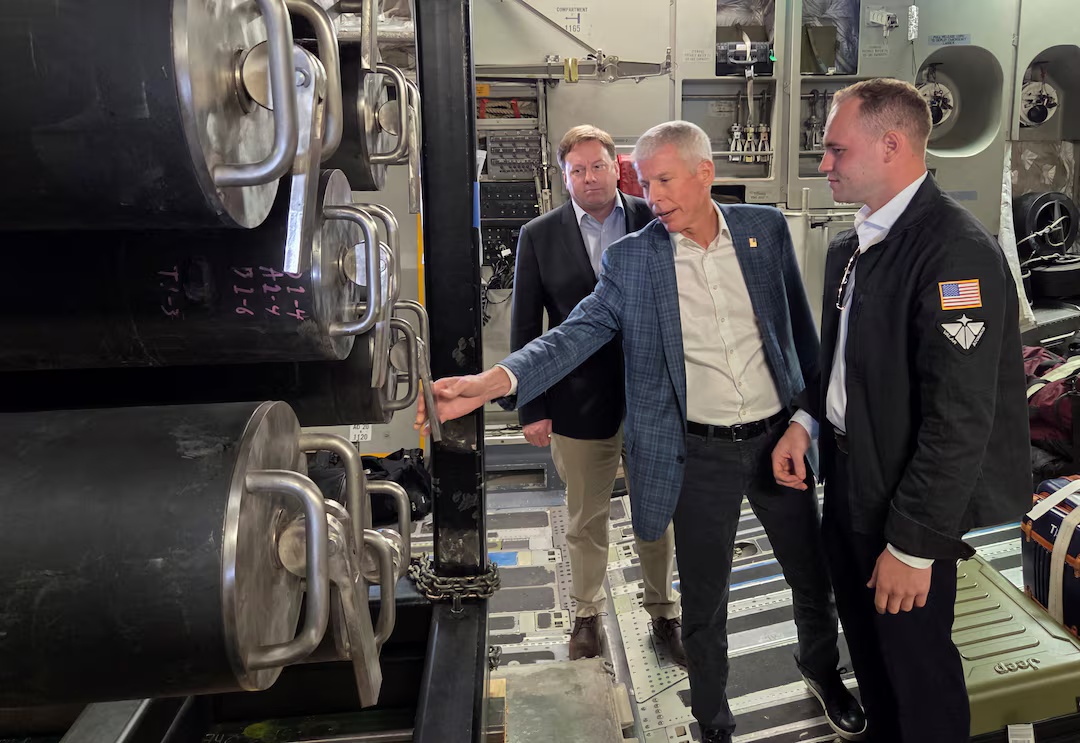
US Secretary of Energy Chris Wright examining a microreactor // Reuters
Either the US military is working to develop Iron Man’s arc reactor and power suit, or it became the latest institution to embrace nuclear power.
What happened: The US Army announced that its Janus Program had selected five vendors to build nuclear microreactors at five bases across the country.
The combined $2.2 billion in spending is targeting more than 20 reactors to be built, with the military hoping to have an operational reactor by September 2028. The reactors will be contractor owned and operated.
Behind the scenes: The Janus Program was launched by the US Department of the Army to develop a next-generation nuclear power program, including microreactors.
The US Department of Energy defines a microreactor as being fully factory-assembled, transportable by truck, rail, ship or air and reliant on passive safety systems.
The American military consumes energy like Post Malone consumes Flamin' Hot Cheestos: The US Department of Defense is the largest institutional consumer of energy in the world and has been the country’s largest user of electricity for decades.
The DoD spends an estimated $16 billion per year on electricity and fuel. And that’s not just volume: airlifting diesel to remote military bases to fuel generators is estimated to cost up to $400 per gallon, making microreactors a more affordable alternative.
And there’s also the human cost to transporting fuel. A report published in 2007 estimated the US military suffered one casualty for every 24 fuel supply convoys in Afghanistan. It wasn't much better in Iraq, where one in 39 convoys suffered a casualty.
The five vendors announced this week:
All five designs announced for the Janus Program this week remain in development, testing or licensing. And there are concerns the domestic fuel supply for the reactors, which use high-assay low-enriched or “HALEU” uranium, may not keep pace with program's demand.
Investment trends: The nuclear sector continues to attract interest from Wall Street, especially off the back of the data center build-out.
Equity investments across fission and advanced nuclear crossed $1.3 billion last year, anchored by some large investments into TerraPower and X-Energy. That’s up from $783 million in 2024 and roughly $60 million in 2023.
Insights for an evolving energy landscape delivered to your inbox.