
Aaron Foyer
Director, Research
Aaron Foyer
Director, Research
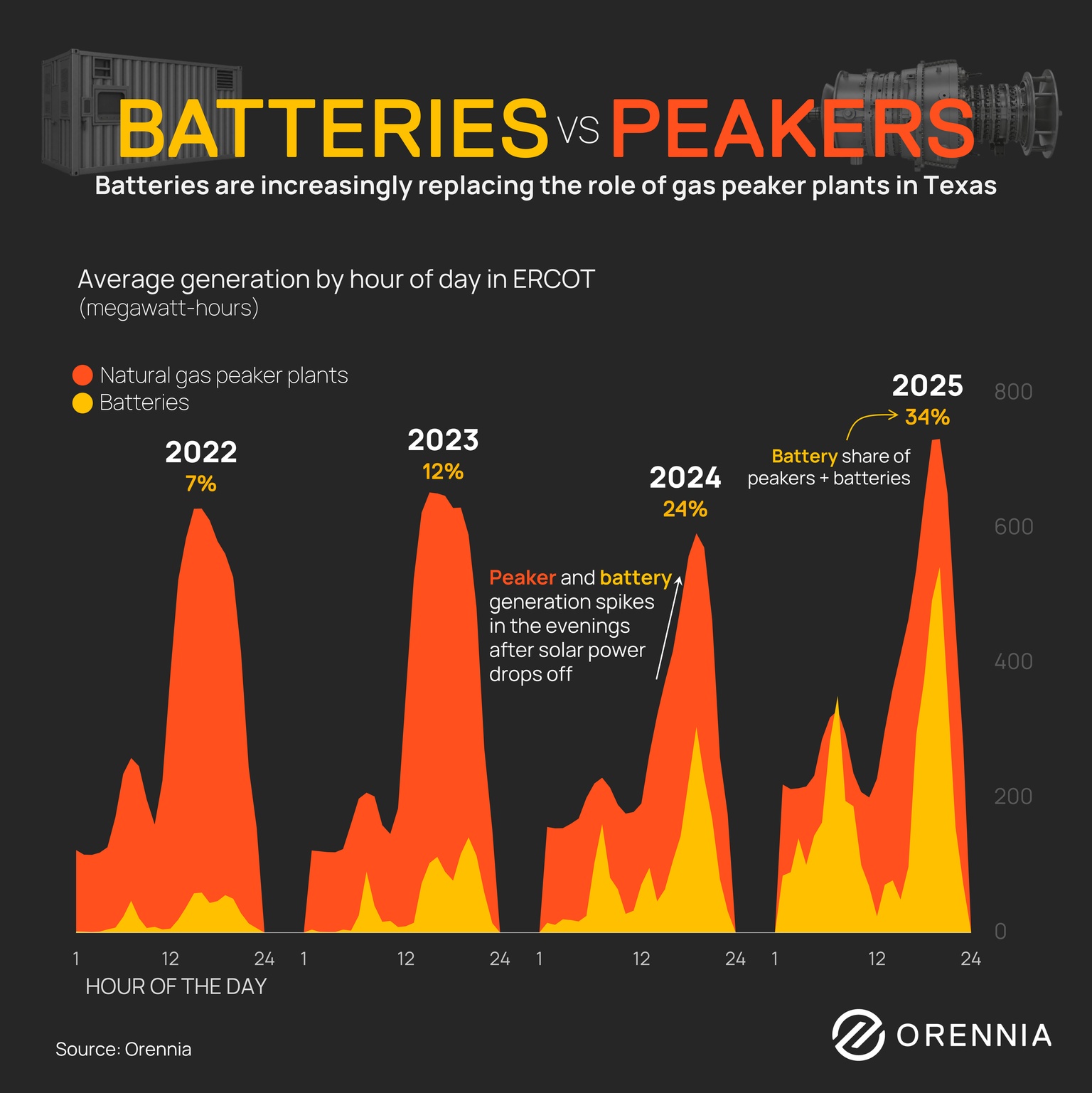
Batteries now account for nearly one in five peaking resources on ERCOT, up from less than 5% in 2022. The electrical grid that serves most of Texas is witnessing a major shift as batteries are starting to displace peaker plants serving periods of higher load on the system.
Natural gas peaker plants are the grid's emergency responders: turbines that sit idle most of the year, spinning up only when electricity demand spikes beyond what baseload power can handle.
Batteries, by contrast, charge when electricity is cheap and abundant, typically during the day, when solar is flooding the grid, and discharge when demand surges. They do the same job as a peaker, filling the gap between supply and demand.
Why batteries are winning
The cost math has flipped: Utility-scale lithium-ion battery costs have fallen roughly 90% over the past decade, making it increasingly economic to build storage instead of a gas plant that typically only runs 100 hours a year. Batteries also respond faster, degrade predictably, and don't require a gas supply chain.
There's also a timing problem working against peakers. The surge in solar generation has created a predictable daily pattern: power floods the grid from midmorning to late afternoon, then drops sharply as the sun sets. Demand in Texas typically peaks around 6pm, making solar + batteries a tailor-made solution by charging during the solar glut and discharging into the evening ramp.
Why is ERCOT leading batteries?
Texas is the right place to watch this shift. ERCOT operates as an islanded grid, almost entirely disconnected from neighboring grids, which means it lives or dies by its own supply and demand balance. It also has the largest installed solar capacity in the US, a deregulated market that prices scarcity aggressively, and summers that push demand to extremes. That combination creates ideal conditions for batteries with high-value evening discharge windows, a volatile market that rewards fast response, and no imports to bail the grid out.
Peakers aren't disappearing. They still provide capacity that batteries, constrained by hours of storage, not megawatts, can't fully replace. But the direction is clear: the grid's most expensive, least-used machines are meeting a cheaper, faster rival. The trends highlight how power markets are evolving.
Insights for an evolving energy landscape delivered to your inbox.