
Aaron Foyer
Director, Research
Aaron Foyer
Director, Research
Note: It’s widely expected that by the end of the decade, quantum computers will reach a level of maturity that they’ll start meaningfully contributing to a major commercial breakthrough and spur interest in the technology the way ChatGPT sparked interest and billions of investments into artificial intelligence.
The following is a memo from 2032, two years after the expected global realization of the technology’s potential, on some very real problems in the energy sector that quantum computing is likely to address.
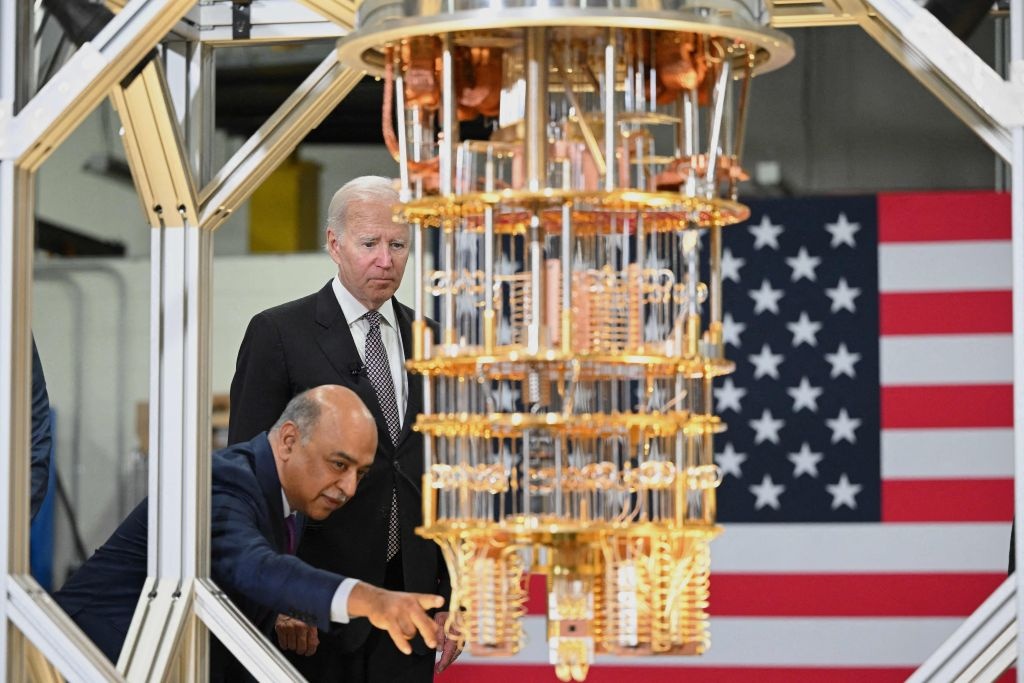
IBM CEO Arvind Krishna shows former President Joe Biden the company’s quantum computer
Getty Images
Brisbane. Summer Olympics. 2032.
I'm three drinks into a rooftop party overlooking the harbor when a startup founder corners me and starts explaining how her business is going to reinvent the power grid with quantum computing. Before I can finish my drink, two more find me. Same story, but different applications.
This is what quantum fever looks like.
For the Olympics themselves, the opening ceremonies were the highlight. Rachel Gunn, former controversial breakdancing Olympian Raygun and now Australia’s prime minister, lit the Olympic torch with a flaming boomerang toss. The crowd lost its mind. The Aussie next to me called it "absolutely legendary." It was a good line, but even that couldn't hold anyone's attention for long.
Quantum is all anyone wants to talk about.
I know all stories about quantum computing these days start with a reminder about how quantum computing works, but the technology is hard to wrap your head around, so a little refresher is always worth it.
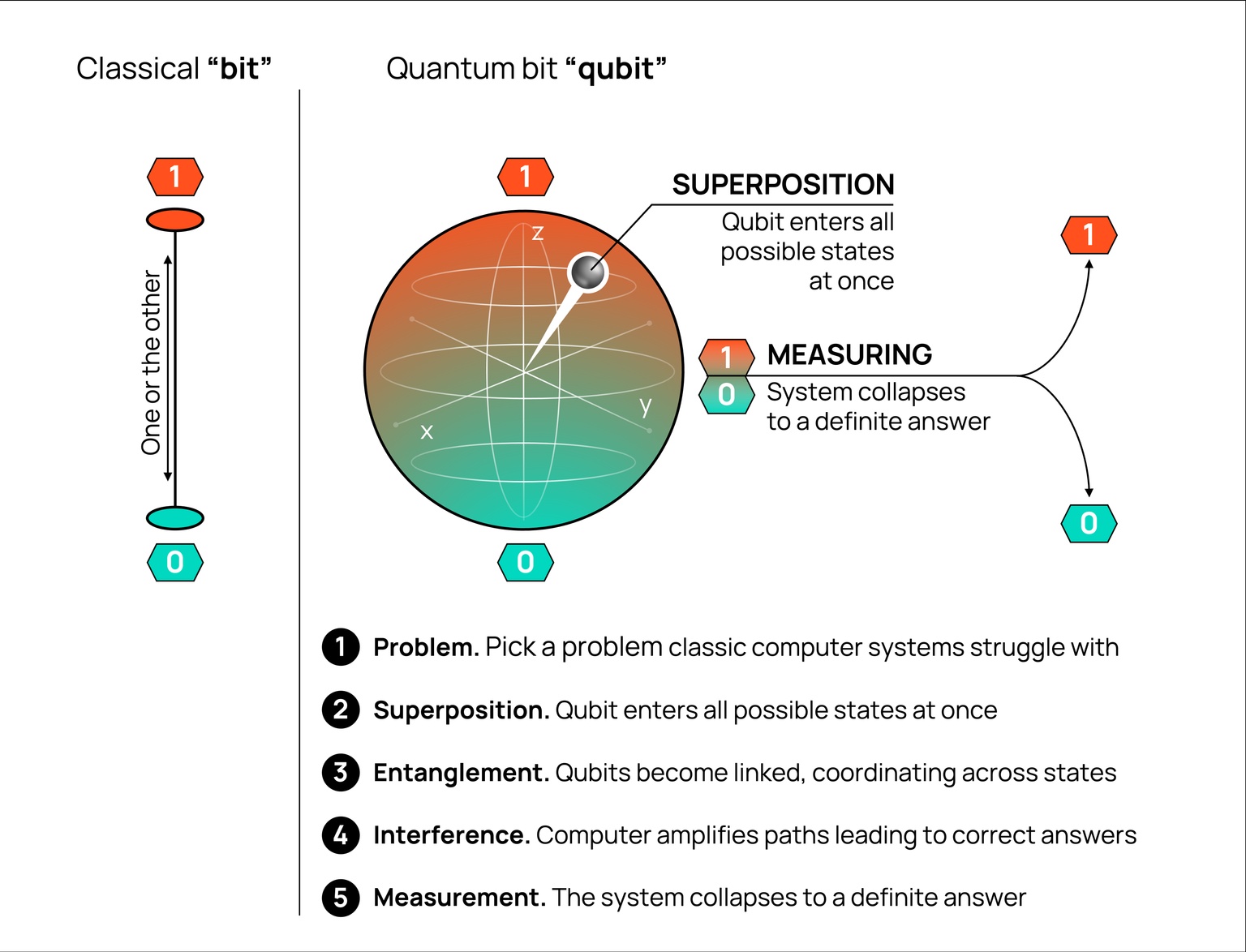
The science: Classical computers, like your laptop, store binary information as “bits,” either a 0 or a 1. The reason everything in classical computing is built on something so simple is that 0s and 1s map perfectly onto the logic of math and algebra.
True/false, yes/no, on/off switches turn out to be great ways to represent everything from numbers, letters, colors and more. An entire digital world can be built atop modern processors that pack billions of transistors onto a piece of silicon the size of a fingernail.
But there are problems that are so large, they require a completely different type of computer to solve.
The “bit” for a quantum computer is called a “qubit.” Instead of a binary transistor, electrons are used. There are a few different approaches, but they all exploit the strange property of electrons called superposition, where a single electron exists in many different positions simultaneously. So instead of being 0 or 1, it can be 0, 1 or another in between. This allows quantum computers to tackle problems that have so many combinations, it would take a lifetime for classical computers to work through.
Source: Orennia
A classic example is having a lamp that requires the exact on/off combinations of four different light switches. A classical computer checks them one at a time, checking all 16 combinations sequentially. But quantum computer armed with four qubits can check all 16 combinations simultaneously.
That may not sound all that impressive, but this simple problem grows quickly the more you add. With four lamps, there are 16 combinations to check. With 10 lamps, there are 1,024. With just 50, there are over a quadrillion combinations to calculate, well beyond what any classical computer could handle. Replace “lamp” with “atom,” “generator,” or “grid node” and you can see how it easily plays into the energy sector.
It’s interesting that what everyone dubbed the “ChatGPT moment” of quantum computers was so different from the actual ChatGPT moment. It wasn’t some novel consumer product that everybody was suddenly using to fix their spelling or build a marathon training plan. Instead, what caught everyone’s attention was Bohr Therapeutics’ breakthrough drug Cognivex that cured Alzheimer’s and the role quantum computers played in it.
Drugs are notoriously hard to model with classical computers. A relatively simple penicillin molecule has 41 atoms, and so could be in more than a trillion different states that researchers would need to individually evaluate. For just a fragment of the amyloid beta peptide protein that’s involved in Alzheimer’s, there are thousands of atoms. Because of the powers of two, there aren’t enough atoms in the observable universe to build a classical computer large enough to hold that calculation and study the protein.
Source: IBM Quantum, Google Quantum AI, Nature, SpinQ, Quantum Computing Report, Tom's Hardware
But with Bohr’s partnership with IBM Quantum, they were able to simulate the amyloid beta peptide’s folding at the quantum level, the actual electron-by-electron quantum mechanical behavior, and found the misfolding wasn’t being driven in the region everyone had previously been targeting. Once they found exactly where and why the protein was misfolding, the rest was easy.
It’s these large number combination problems like protein modeling, surprisingly common in the energy sector, that many of the young entrepreneurs I met last week are looking to tackle.
Here’s a handful of the most exciting startups I heard about:
Ionara: Let me tell you, electric vehicles are about to take a huge step change in performance because of companies like Ionara. Batteries are notoriously hard to innovate because many of the most important reactions happen at the quantum level, especially with the electrolyte. Battery electrolytes are typically big molecules and so a lot of the modeling at the interface between the liquid and the electrode is mostly just approximations. That’s helpful, but it’s not a step change.
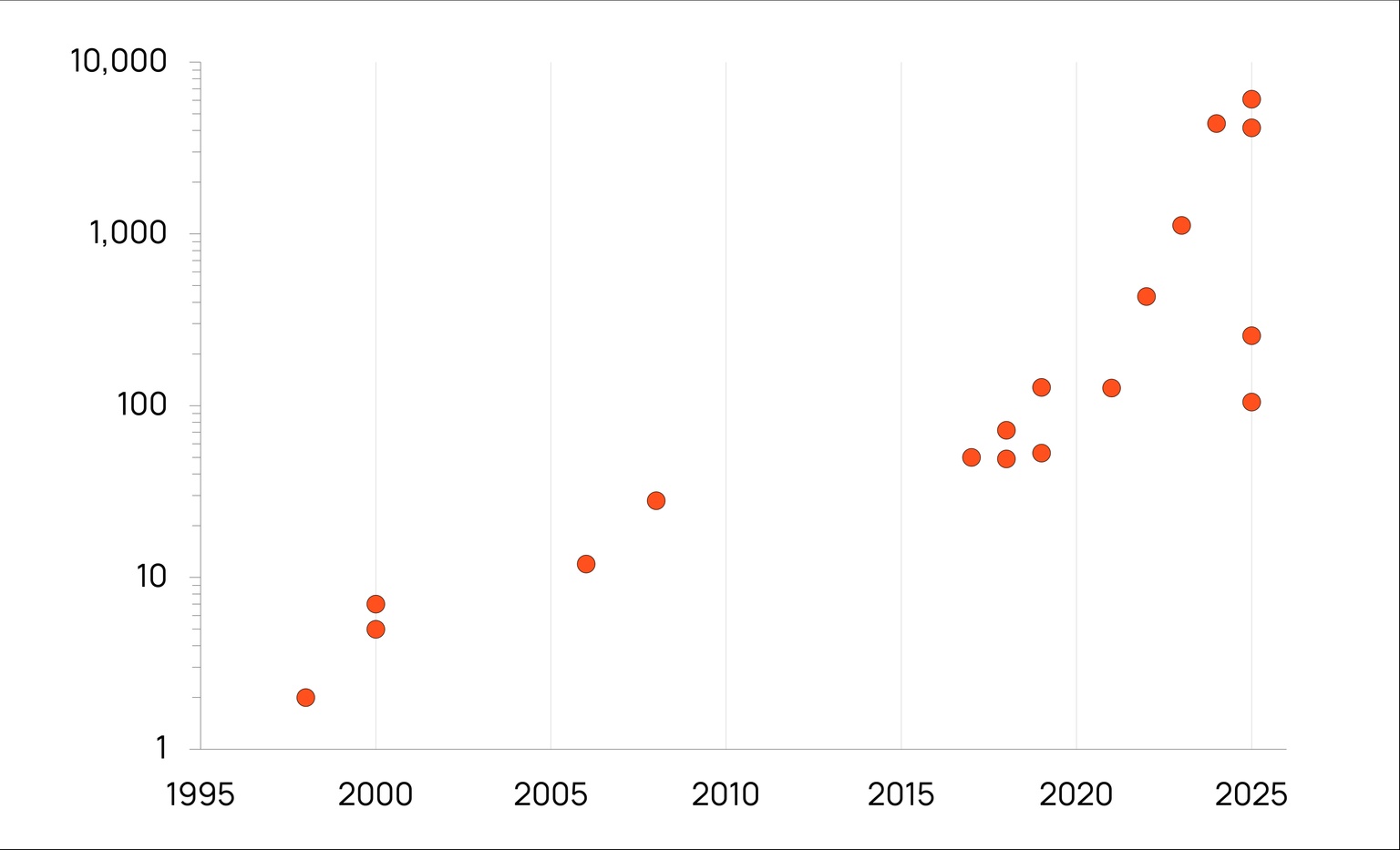
Ionara, led by CEO Nadia Kern, is working on batteries that have been studied at the quantum level to charge faster, last longer and not catch fire. Volkswagen and IQM Quantum Computers did something similar nearly a decade ago, as did Phasecraft, but were limited by a small number of qubits. Now that we have computers with 10,000 qubits, Ionara can model these properly.
Captura: The carbon capture industry has been quiet of late, but there’s a good chance that quantum computing helps change that.
I met this chemical engineer down in Brisbane named Adil Choudhry. His startup Captura is working on better solvents to trap carbon dioxide molecules. The challenge the carbon capture industry faced over the last decade is well understood: The amine solvents companies are using in need heat to release the captured carbon dioxide. That reaction heat consumed so much energy, it essentially killed the economics for carbon capture. Some 60% to 80% of energy used in the carbon capture process goes to solvent regeneration.
Most of those old amine solvents were discovered through trial and error. But Choudry and his team are instead using quantum computers to understand exactly how carbon dioxide molecules bind and release from solvent molecules with the goal of finding one that releases with minimal energy input. That would help bring the cost of the technology down to make it competitive.
Voltara: This one might be the most interesting.
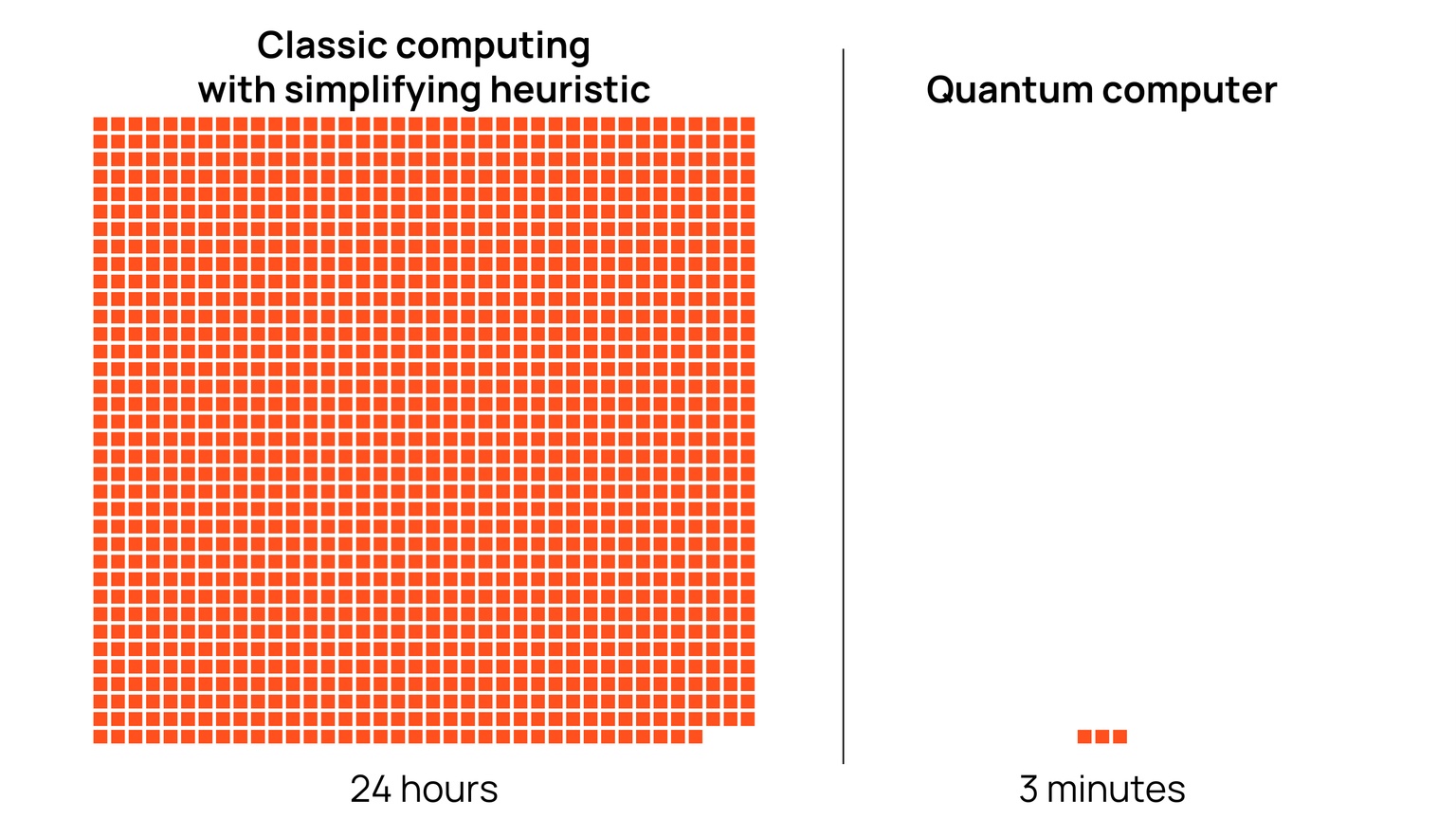
It’s often underappreciated how hard it is to run a power grid. Imagine trying to coordinate which power plants on a grid should be on and off on a small grid with just 20 generators. That’s roughly a million different combinations. With grid operators typically scheduling 24 hours ahead and each of those generators being either on or off for each of those hours, the total number of combinations there has 144 digits. Compare that with the number of atoms in the observable universe, which has about 80 digits. And 20 generators is a small grid compared to something like ERCOT.
Source: Shift Lab estimates
Grid planners today use approximations that work but lead to huge inefficiencies that consumers pay for. Back in June 2025, IonQ and Oak Ridge National Laboratory solved a 26-generator problem with quantum computing that landed within 1% to 3% of the mathematically perfect answer. For a utility that might spend $10 billion a year on generation, even a 1% improvement is $100 million in savings.
Voltara is taking that to next level. The US grid has over 80,000 nodes, with localized marginal pricing happening at each. Classical computers have no chance of modeling this, but Tara Osei and her team over at Voltara do, which could lead to energy savings, avoided costly grid upgrades and reduced curtailment.
These were the three most interesting startups I chatted with in Australia, but there were many more.
Several companies were working on optimizing energy systems — transmission congestion management, battery fleet optimization and even energy trading. There were dozens focused on materials discovery, like better batteries, improved electrolysis chemistries and synthetic fuels research. And almost every resource company is working on reservoir modeling, whether it be for oil and gas, geothermal or underground carbon dioxide storage.
But the big takeaway I had through all my conversations is that the quantum computing age will lead to less energy consumption by the sector, not more. Unlike AI, which requires data centers in the hundreds of megawatt range, we’ve seen early quantum facilities use just a fraction of that. Five megawatts for supercooling and some cryogenics, but nothing like what the hyperscalers are doing.
And that increase in power use will be dwarfed by the efficiency gains that come out of quantum research. Even small improvements in grid efficiency could save gigawatt-hours of wasted energy annually, easily enough to cover the incremental power use of the fairly modest facilities housing quantum computers.
Bottom line: Going back more than a century, there have been loads of known problems in the energy space that have just been too complicated to solve. Now we finally have the computers to tackle them.
Looking to learn more about how Orennia can support data center development and investment? Click here.
Insights for an evolving energy landscape delivered to your inbox.