
Aaron Foyer
Director, Research
Aaron Foyer
Director, Research
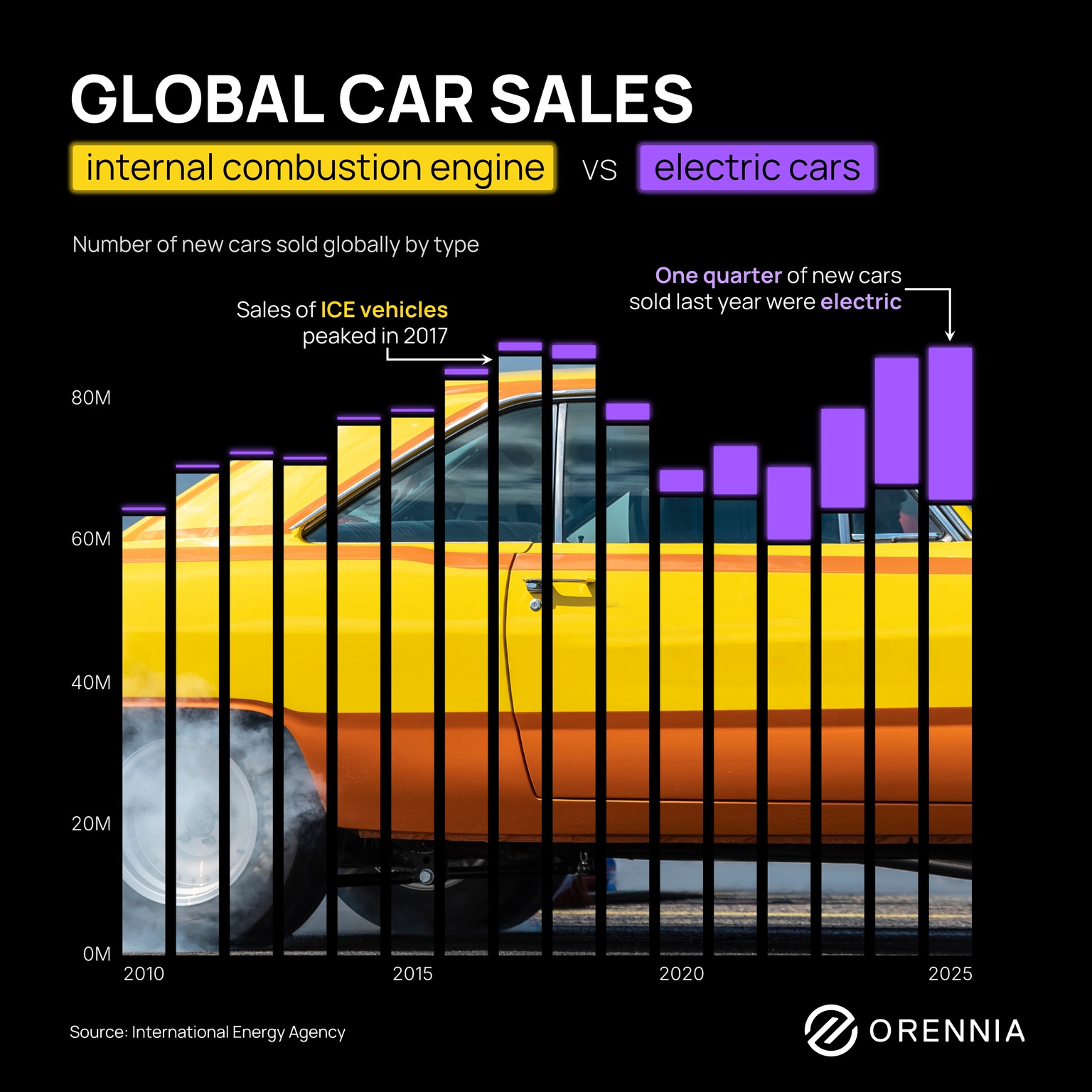
One in four new cars sold globally in 2025 was electric, totaling 20.7 million units, according to data from the International Energy Agency. Electric vehicles have increasingly accounted for new vehicles, with internal combustion engineer sales peaking in 2017 and have declined since.
But despite the global growth of electric vehicles, trends are very regional.
Why are EVs growing?
China: The Asian giant’s EV boom is starting to mature. The country sold 12.8 million EVs in 2025, capturing 52% of its auto market and nearly two-thirds of global EV sales. But growth has slowed sharply after years of rapid expansion, with sales rising just 4% year-over-year in the fourth quarter.
With major cities nearing saturation and new purchase taxes arriving in 2026, Chinese automakers are increasingly looking overseas. Exports doubled last year, led by BYD, and Chinese-made EVs are gaining ground from Europe to South America, turning China into both the world’s largest EV market and its leading EV exporter.
Europe: Europe’s EV market is accelerating fast. Electric vehicles now make up 28% of new car sales, up more than 30% year over year, the strongest growth among major regions. In early 2025, roughly one in four cars sold across Europe was electric. The UK alone registered nearly half a million new battery EVs.
The surge is being driven by policy. Stricter EU emission standards are pushing automakers to ramp up EV production. But there are early signs of pushback: In March 2025, the European Commission introduced more flexibility in meeting emissions targets, a reminder that regulatory pressure can shift with political priorities.
United States: The US EV market is still stuck in neutral. Electric vehicles hold around 10% of sales, even after years of policy support. Momentum slipped late in 2025, with Q4 marking the weakest sales since 2022 as Biden-era subsidies expired. Sales stalled further heading into early 2026.
That was, until fuel prices spiked. Oil surged past $110 per barrel after the Strait of Hormuz disruption, pushing US gas prices to an average of $4.10, with California nearing $9. Early data from Edmunds shows more shoppers starting to consider EVs as fuel costs climb.
Insights for an evolving energy landscape delivered to your inbox.