
Aaron Foyer
Director, Research
Aaron Foyer
Director, Research
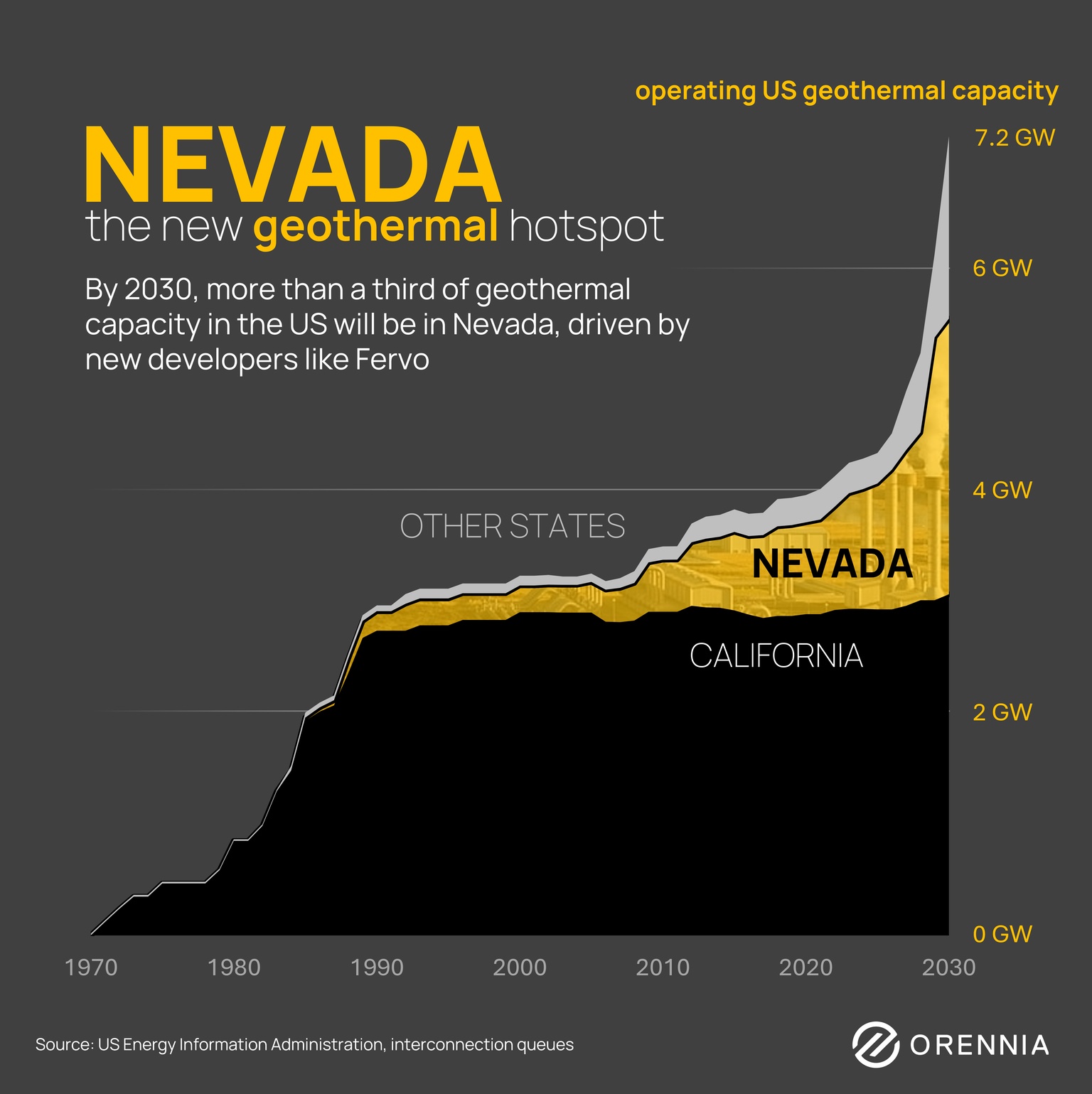
Nevada is emerging as America’s new geothermal superpower as enhanced geothermal systems unlock the Great Basin’s heat flow using shale‑style drilling techniques.
For half a century, America's geothermal was focused on California due to its unique geology. But engineering has helped move the focus of development to a new state: By 2030, more than a third of US geothermal capacity will be concentrated in Nevada, driven by a new generation of developers deploying drilling techniques borrowed straight from the shale patch.
The California era: In 1960, Pacific Gas and Electric began commercial operation of an 11-megawatt plant at The Geysers, a dry steam field in the Mayacamas Mountains about 72 miles north of San Francisco.
The magma chamber lies less than a kilometer from the surface, producing dry steam that could be piped directly into turbines without much processing. But without similar geology, it’s an energy system that’s impossible to repeat.
Why Nevada is different
Nevada is part of an area of much higher average heat flow than the rest of the United States. In north-central Nevada, geothermal gradients reach as high as 64°C per kilometer in bedrock, the result of a combination of thin crust and high-temperature upper mantle. Nevada sits within the Great Basin, one of the highest heat‑flow regions in North America, averaging ~90 milliwatts per square meter of heat flow. Far above the continental norm. Nevada now ranks second in U.S. geothermal capacity and is expected to account for a growing share of new geothermal additions
In short, the Silver State has the geology of a geothermal superpower waiting for the right technology to unlock it.
The Shale playbook, applied to geothermal: Next-generation geothermal developers like Fervo realized that the horizontal drilling and hydraulic fracturing techniques perfected in the US shale boom could be repurposed to create artificial reservoirs in hot dry rock. Instead of searching for a natural hydrothermal system, they’re looking to manufacture them.
Fervo's Project Red in northern Nevada became the most productive enhanced geothermal system in history, achieving a flow rate of 63 liters per second at high temperature, enabling 3.5 MW of electric production with the first-ever horizontal well pair drilled for commercial geothermal production.
Insights for an evolving energy landscape delivered to your inbox.