
Aaron Foyer
Director, Research
Aaron Foyer
Director, Research
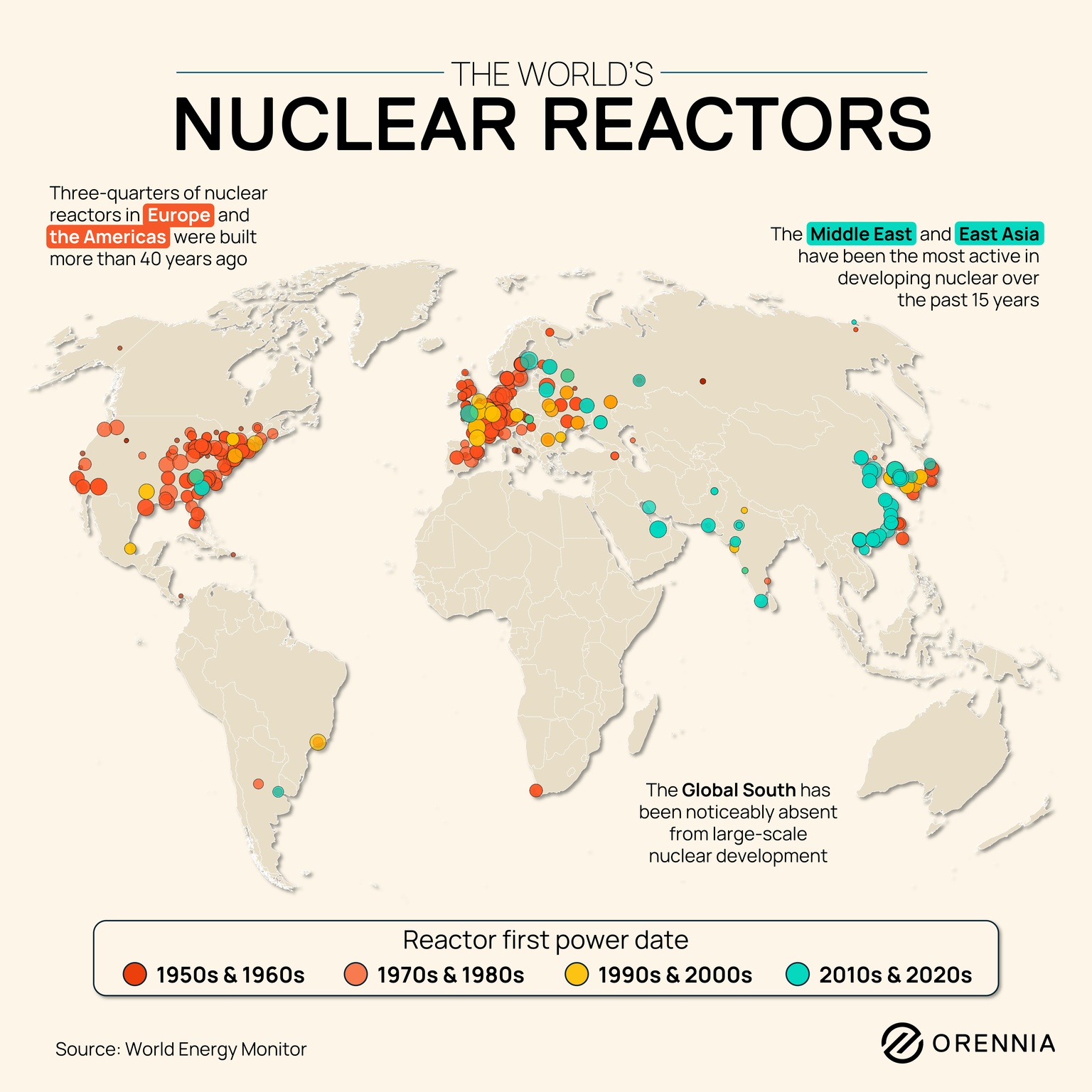
There has been a fundamental change in nuclear development across the world over the last 20 years. Nuclear power generation was something historically dominated by the US, Canada and Europe, but has shifted to the East as concerns about energy security and power demand in the region have both grown.
Why did the West build nuclear first? 75% of reactors in Europe and the Americas came online more than 40 years ago, according to data from the World Energy Monitor. The first wave of nuclear construction was shaped by two forces that no longer exist in the same form: Cold War geopolitics and cheap, government-backed financing.
Governments in the US, Canada and Western Europe bankrolled early programs, utilities operated in regulated monopoly structures that allowed cost recovery regardless of overruns and public acceptance was comparatively high. The US had 40+ reactors under construction simultaneously by the mid-1970s. France, operating under a standardized state program, built 58 reactors in roughly 25 years.
But the excitement eventually faded: Three Mile Island in 1979 eroded American public confidence and triggered a regulatory tightening that stretched construction timelines and inflated costs. Chernobyl hit Europe harder, accelerating moratoria in several countries and killing developments in others. Cheaper natural gas in the 1990s removed the economic urgency for nuclear power, and by 2000, the West had effectively stopped building new nuclear plants.
Why Asia is building now: Asia's nuclear buildout is driven by electricity demand growing faster than any single fuel source can satisfy, acute energy security concerns and governments with the capacity and risk appetite to finance long-cycle infrastructure.
China is the clear example, with roughly 20 reactors under construction at any given time over the past decade. That number now stands at 30. The Asian giant treats nuclear as one component of an all-of-the-above energy expansion alongside solar and wind. State ownership of both utilities and construction firms eliminates the financing friction that has made Western projects like Hinkley Point C and Vogtle cautionary tales.
What’s the future of nuclear energy? Excitement about nuclear power has grown in the West with demand for electricity from data centers. A wave of advanced reactors, small modular reactors and even microreactors are attracting investment and could lead to the next wave of nuclear development.
+Bonus infographic: Global Uranium Production

Insights for an evolving energy landscape delivered to your inbox.