
Aaron Foyer
Director, Research
Aaron Foyer
Director, Research
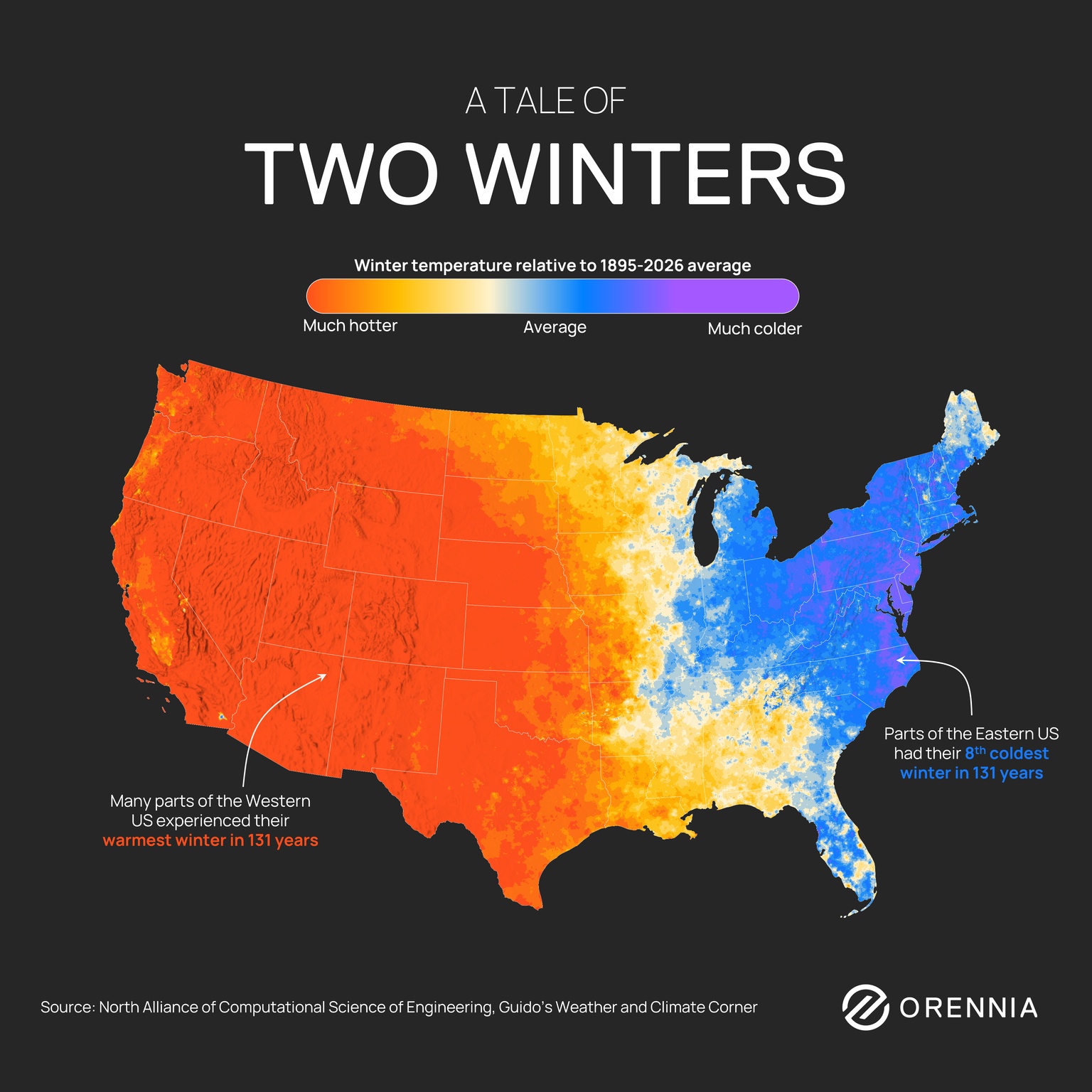
If you lived west of the Rockies this past winter, you probably didn't need a coat. If you lived east of them, you needed several.
Using more than a century of historical winter temperature data provided by the North Alliance of Computational Science of Engineering PRISM dataset, the just-concluded winter (December through February) was one of the starkest climate splits in modern American history.
In the West, it was one of the warmest in history, relative to the long-term winter temperature average dating back to 1895. Nine large western states — Arizona, Idaho, Nevada, New Mexico, Oklahoma, Oregon, Texas, Utah, and Wyoming — each recorded their warmest winters ever.
The eastern story was markedly different. Several disruptive cold events battered the eastern US, including a mid-December cold period across the Midwest, a late-January cold snap that left temperatures across 34 eastern cities averaging more than 22 degrees Fahrenheit below normal, and a historic late-February blizzard that swept from the Mid-Atlantic to New England.
The consequences out west are already materializing. Statewide snow water equivalent measured by SNOTEL stations in Colorado reached its lowest early-February level since at least 1987, approaching deficits seen during historic drought winters of the 1970s and '80s.
The Colorado River Basin, which is already under stress, is heading into another dry year with a depleted snowpack buffer. Wildfire risk across the region is elevated heading into spring.
Insights for an evolving energy landscape delivered to your inbox.