
Aaron Foyer
Director, Research
Aaron Foyer
Director, Research
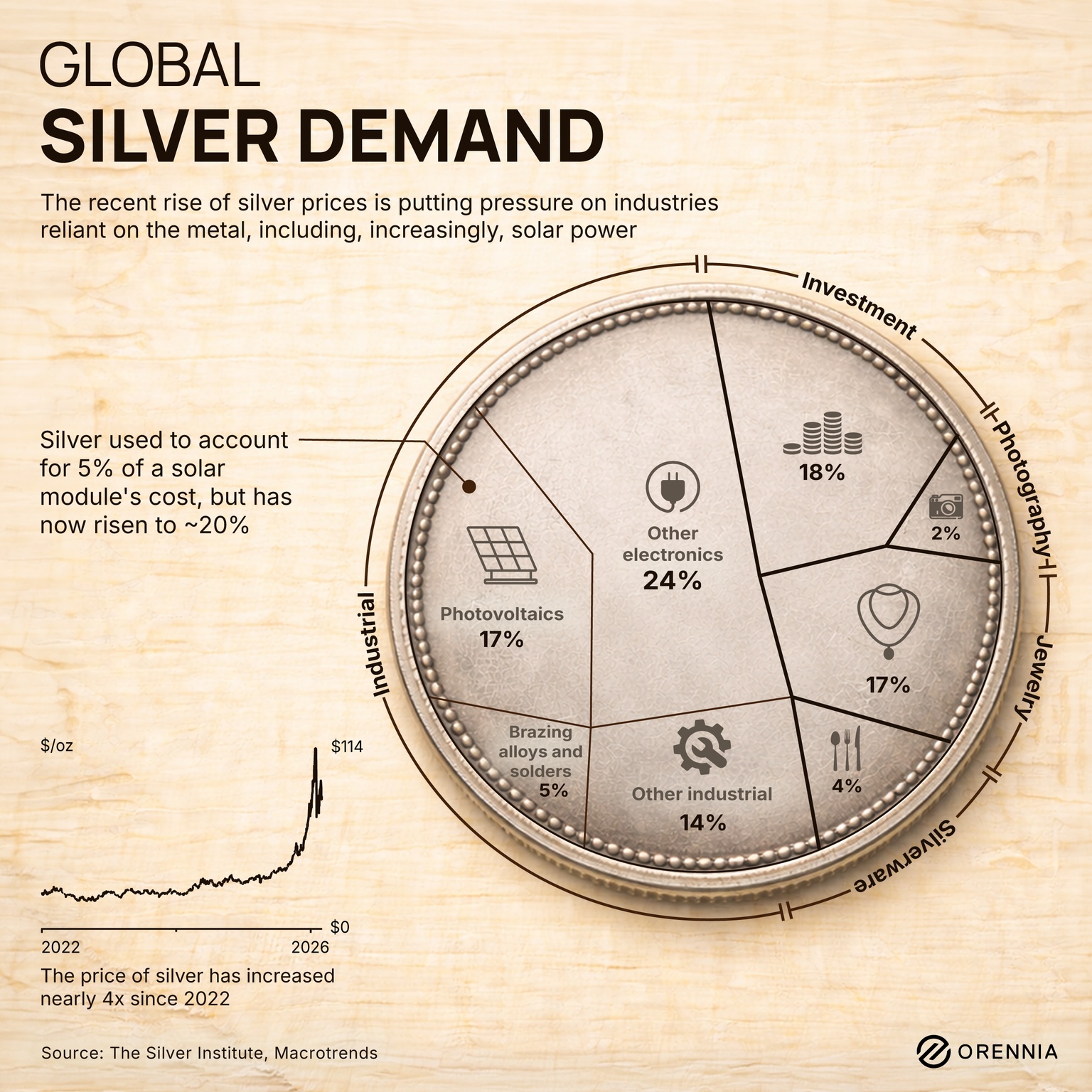
Silver has long been the quiet workhorse of the global economy, essential in everything from electronics and jewelry to medical devices and clean energy. But a nearly 4x surge in prices since 2022 has pushed it firmly into the spotlight, forcing industries that depend on it to confront a new cost reality.
Nowhere is this pressure more acute than in solar power, where silver's share of a module's total cost has jumped from roughly 5% to nearly 20%, according to Metals Focus. There was 36.2 gigawatts of utility-scale solar capacity that came online between the US and Canada last year, according to Orennia.
The estimated demand for silver last year by sector, according to The Silver Institute.
Silver is mined primarily as a byproduct of lead, zinc, copper, and gold operations, meaning supply is largely inelastic and slow to respond to demand signals. That constraint has contributed to a dramatic price run-up: silver has climbed nearly 300% since 2022, reaching $114 per troy ounce earlier this year.
The solar industry is facing a particular squeeze, with the precious metal, which is used for its electrical conductivity, now accounting for nearly one-fifth of panel costs. As a result, firms are actively working to reduce the amount of silver used in panels.
Insights for an evolving energy landscape delivered to your inbox.