
Aaron Foyer
Director, Research
Aaron Foyer
Director, Research
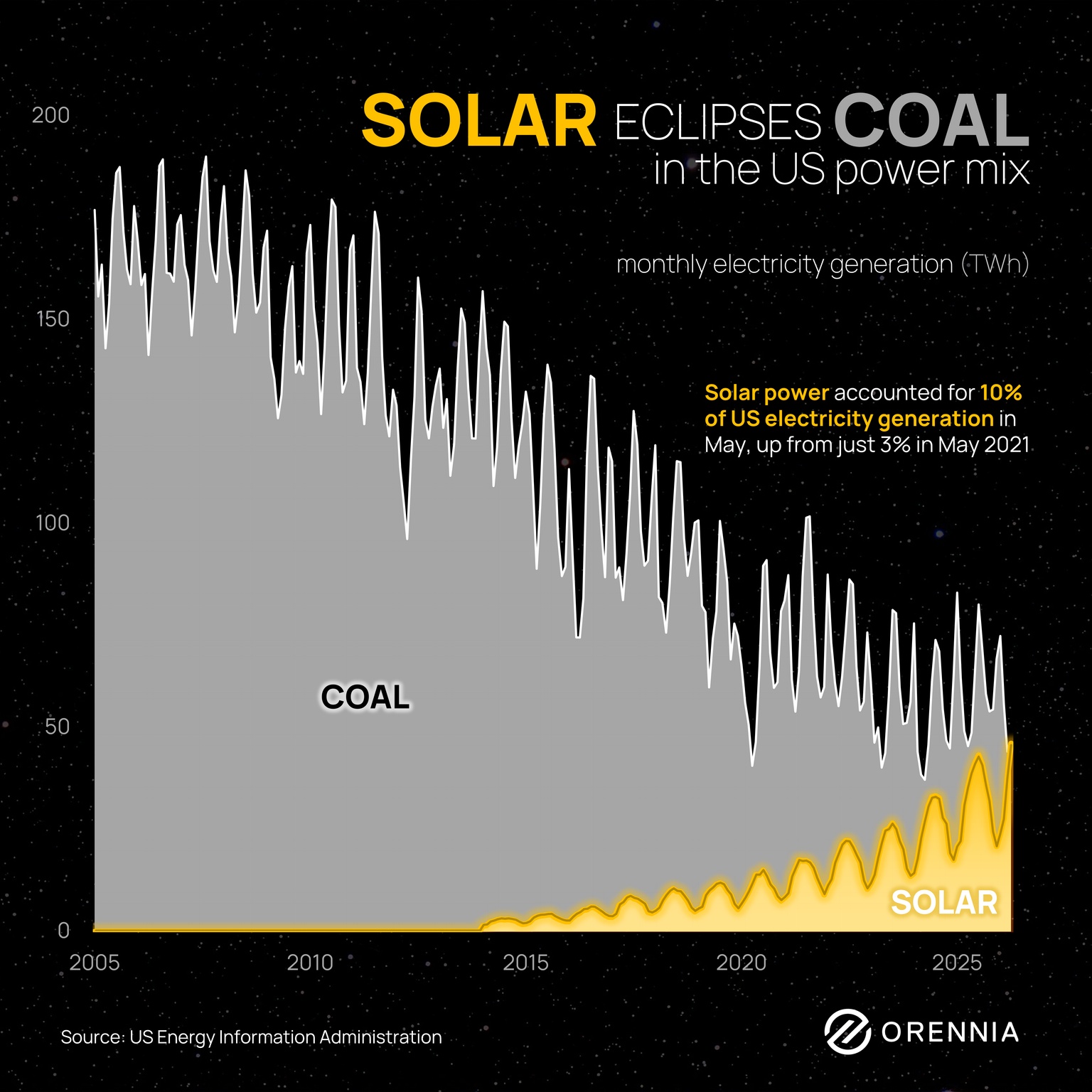
Coal dominated US electricity generation for most of the 20th century, peaking at roughly half the country's power supply in 2007. That has seen a steady reversal over the past two decades.
Coal’s decline: By 2024, coal consumption had fallen 64% from that peak, driven by competition from natural gas and, more recently, renewables. The shale boom of the late 2000s made gas cheap enough to displace coal as the grid's primary fuel. Natural gas overtook coal as the largest source of US power generation in 2016.
The story of coal’s fall has many chapters, but includes higher environmental regulations, cheaper alternatives and even changing railroad rates.
Solar has followed the opposite trajectory. Developers added 31 gigawatts of utility-scale solar capacity in 2024, increasing total US solar capacity by 34% in a single year. Solar reached 10% of US electricity generation in May, up from just 3% in May 2021.
Solar’s growth can initially be attributed to supportive policy, but now that it’s one of the cheapest sources of generation not constrained by supply chains, it’s become highly competitive in most power markets.
The pushback
The Trump administration has pursued a range of measures to slow coal's decline.
In April 2025, executive orders designated coal as a mineral, removed barriers to mining on federal lands, and rolled back Biden-era restrictions on coal plants. The DOE has issued 19 emergency orders blocking plant closures on grid reliability grounds, claiming more than 17 GW of coal generation was preserved in 2025.
The broader challenge for coal is cost. A 2025 Lazard analysis put coal-fired electricity at $122 per megawatt-hour, compared to $78 for natural gas, $61 for onshore wind, and $58 for utility-scale solar.
The EIA projects coal production declining through 2026, with gas and renewables continuing to take market share. According to the US Energy Information Administration, developers plan to add 43.4 gigawatts of new utility-scale solar capacity in 2026, a 60% increase over 2025 additions. By contrast, the EIA projects no new coal capacity this year.
Insights for an evolving energy landscape delivered to your inbox.