
Aaron Foyer
Director, Research
How will AI-driven forecasts make the grid cheaper?
Aaron Foyer
Director, Research
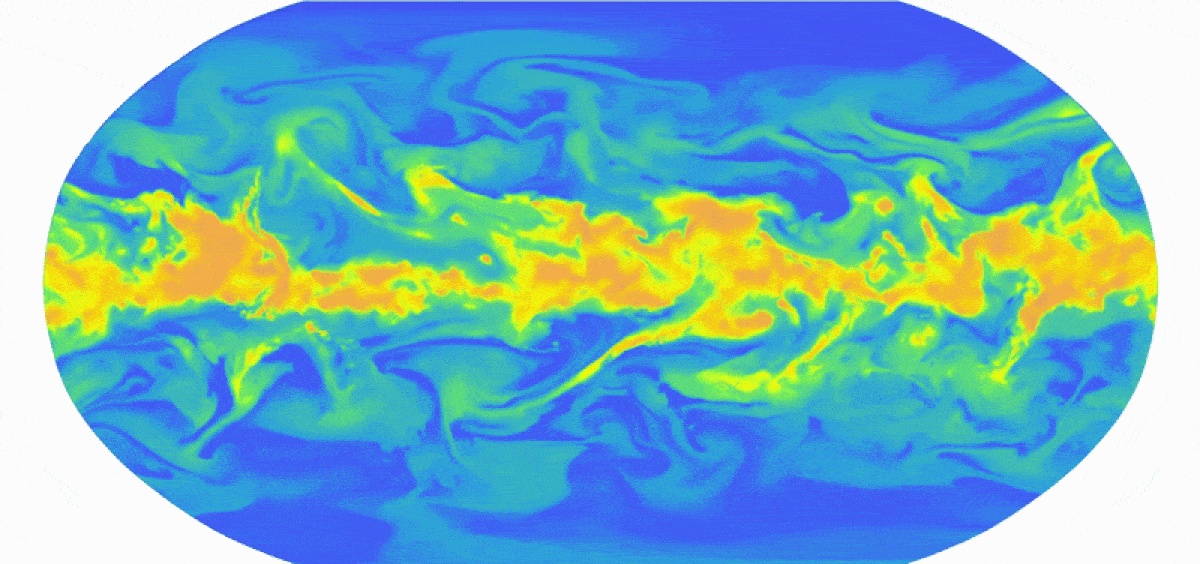
Source: Google DeepMind’s WeatherNext 2
Here is every dad for the last 80 years: “A weatherman is someone who tells you tomorrow will be nice then apologizes the next day.”
*slaps knee*
OK, a couple of things wrong with this one: First off, it’s 2026 and the professionals are called “weather forecasters” or just “meteorologists.” Secondly, those meteorologists are now remarkably accurate. Decades of investment in satellites, international data gathering systems and supercomputers have greatly improved weather forecasts.
But the science is in the midst of a major step change in performance due to AI. A completely new approach to meteorology that incorporates the latest technology coming out of Silicon Valley is already outperforming today’s best models. And beyond just informing you whether it’s a good idea to wear white sneakers outside, better forecasts will also transform the energy industry.
So, how will AI-driven forecasts make the grid cheaper? Let’s read the radar and predict what’s ahead.
A lot has changed in the science of predicting the weather since Aristotle wrote Meteorologica back in 340 BCE.
For millennia, the practice was a blend of observation, folklore and cultural memory, more akin to the Freman of Dune than science. During the 17th century, polymaths including Evangelista Torricelli, Blaise Pascal and Galileo developed tools like barometers and thermometers that would help transform weather from mysticism to mechanical.
But the real Lisan al-Gaib of meteorology is John von Newmann, sometimes considered the smartest man who ever lived, who realized in the 1940s that early computers could finally solve the fluid flow and thermodynamic equations needed to truly predict the weather.
By incorporating pressure, temperature and other atmospheric data points collected from across the globe, physics models spun through computers could predict how the atmosphere was likely to evolve and what that meant for upcoming weather.
Since then, forecasts have only got better, mostly by incorporating more data and better underlying models. Satellites now collect high-fidelity data from around the globe in real time, which vast gathering systems can quickly assimilate and feed into supercomputers that then run some of the most sophisticated algorithms humans have ever built.
In plain English, today’s models divide the world up into millions of tiny grids, apply the laws of physics and then move the movie forward one frame at a time.
Current conditions: There are now more than 200 billion weather observations made each day around the world, from satellites, weather balloons, airplane sensors and on-the-ground instruments.
In a paper published in Nature, researchers found the accuracy of forecasts has been improving by about a day per decade, meaning the six-day forecast today is as good as the five-day forecast was a decade ago.
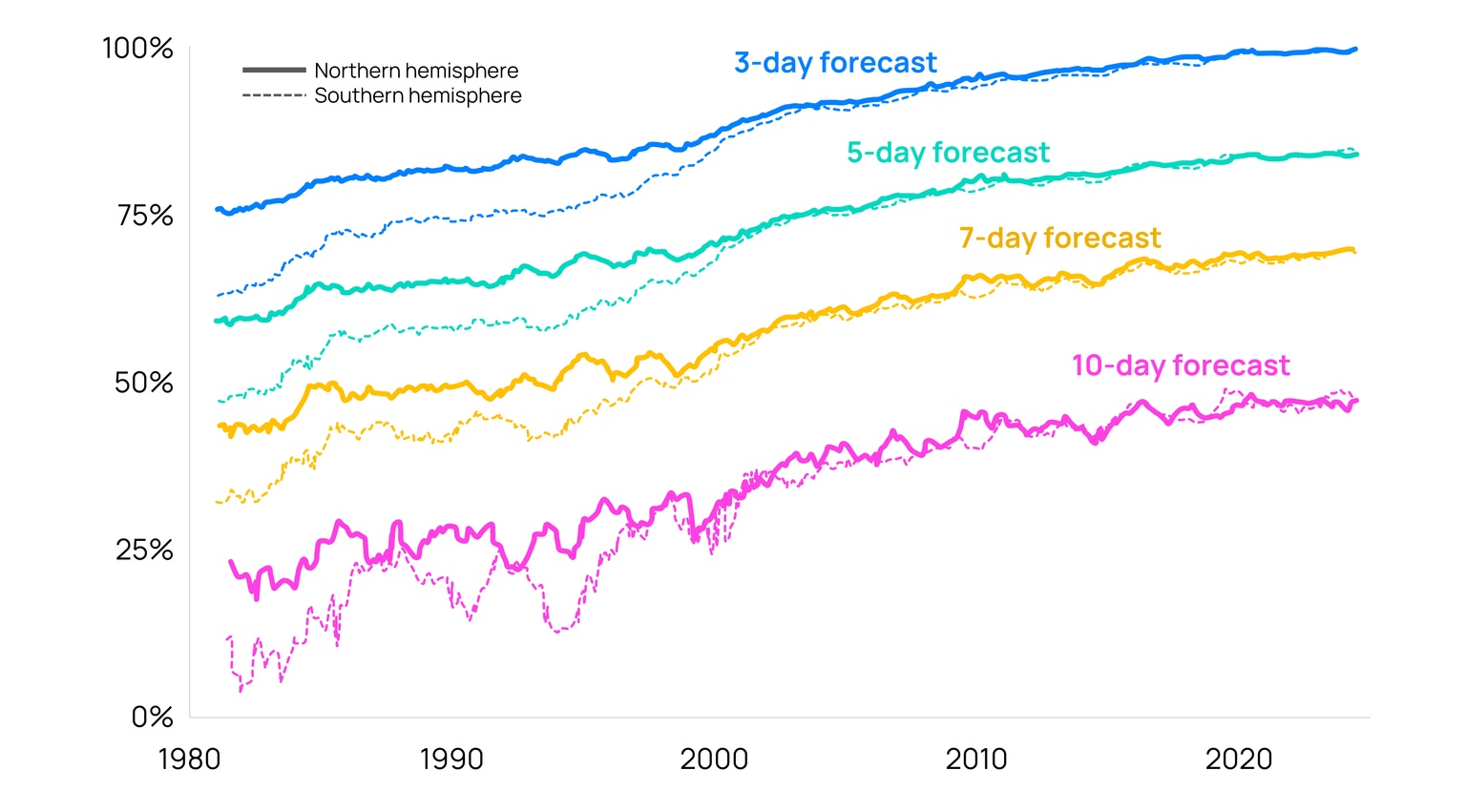
Source: European Center for Medium-Range Weather Forecasts
And forecasts can be a matter of life or death. On how tropical cyclones evolve, the US National Oceanic and Atmospheric Administration found errors on the 5-day outlook declined by roughly half since the mid-1990s, while the error on the intensity of the storm dropped by nearly 30%. That could be the difference between living through a Cat 5 hurricane and boarding up and getting the heck out of Dodge.
Like most industries, meteorology has been upended by AI. It would be easy to fall into the trap of thinking that artificial intelligence is simply making the existing models of weather forecasting better, but that’s not the case. The latest AI models coming out of shops like IBM and Google DeepMind are a complete departure from the olden ways of predicting the future.
Instead of a frame-by-frame giant physics calculator, teams are training models on decades of global data, learning statistical relationships across space and time, and using those to predict the next atmospheric state directly.
In other words, as opposed to asking, “Given physics, what happens next?” teams armed with AI are asking, “Given everything we’ve ever observed, what usually happens next?”
The results are astonishing: Despite being a relatively new approach, the AI-based models are already outperforming even the best conventional models. They make Al Roker look like “I love lamp” Brick Tamland.
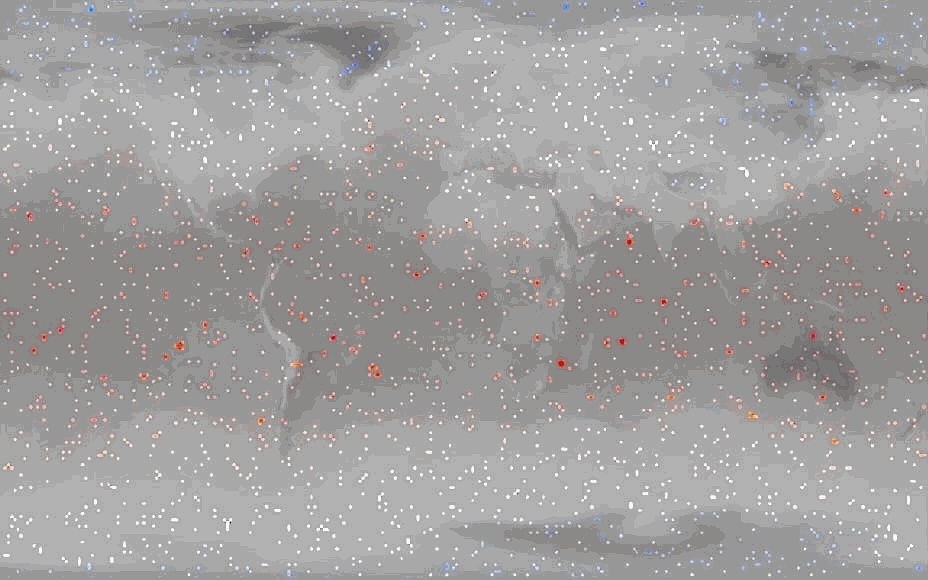
Source: Images from IBM, adapted by Orennia
The independent European Center of Medium-Range Weather Forecasts found its Artificial Intelligence Forecasting System, which integrates machine learning and AI, outperforms state-of-the-art physics-based models by as much as 20% on many key measures. The AIFS can also predict hurricane tracks 12 hours further ahead than other models.
And the AI-based models are doing this all using less energy and costing less to build than the traditional physics-based models.
Nvidia found accurate weather models can be built with accelerated computing using just 0.5% of the investment and 0.3% of the energy of traditional systems. The American chipmaker is talking its own book, so take those with a grain of salt, but even if the real numbers are an order of magnitude larger, they’re still transformative.
Beyond the energy used to make and use the models, being able to better forecast the weather will transform the energy sector itself.
A more reliable grid: In the post-mortem of Winter Storm Uri in 2021 that led to 9.9 million people experiencing blackouts and the death of at least 290 people, the US federal energy regulator found three-quarters of the unplanned generator outages and failures were the result of either equipment freezing or fuel issues. With a better heads up, operators can pre-stage maintenance crews and work to protect vulnerable pieces of infrastructure, avoiding costly and deadly outages.
Lower costs: Since renewables are so weather dependent, being able to better predict the weather means being able to better orchestrate the various parts of the grid.
The NOAA noted its improved weather model helped consumers save $150 million per year from utilities being able to plan generation more efficiently and thus reduce costly imbalance charges that get passed along. Researchers also found better weather forecasts could meaningfully improve the performance of large hydro dams.
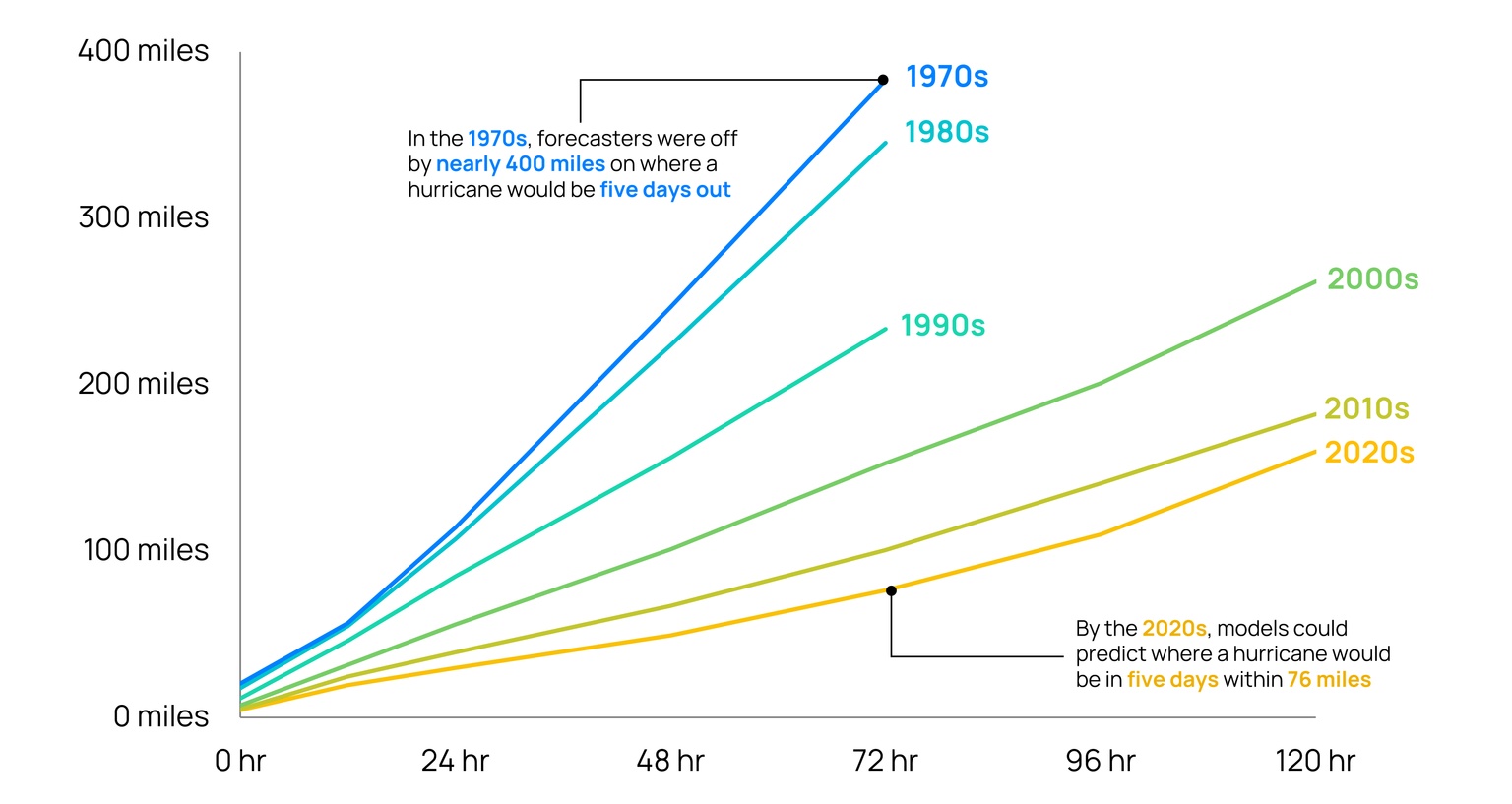
Source: National Hurricane Center via Hannah Ritchie
A study in Switzerland found without weather forecasts to help in supply-demand matching, the costs to import electricity in the country would jump 36%.
And the benefits go beyond the power sector. A study last year found that early or precautionary refinery shutdowns along the US Gulf Coast, triggered by uncertain hurricane forecasts, can cost facilities as much as the storms themselves.
Big picture
The weather business is a good one to be in: 68% of US consumers check the weather on their phones daily, making weather apps alone a billion-dollar market. And if you’re not fond of the forecast, there are even second-order businesses to help you out: Etsy witches can cast spells to help fend off rain on your wedding day. Alanis Morisette would have been thrilled.
For governments, being prepared can be a windfall. On the cost side, the bill for extreme weather is adding up — the US faced nearly a trillion dollars in damage from extreme weather between 2023 and 2024. Encouragingly, the US National Bureau of Economic Research found improvements in forecasting have reduced the cost to the government by $5 billion per hurricane.
And on the revenue side, researchers in China looking at the relationship between economic output and better forecasting found a 1% improvement in meteorological accuracy increased the output of weather-sensitive industries by 2% to 3%.
Bottom line: The real story isn’t that artificial intelligence can tell you if it will rain, it’s that AI is helping shrink the economic cost of uncertainty.
Insights for an evolving energy landscape delivered to your inbox.