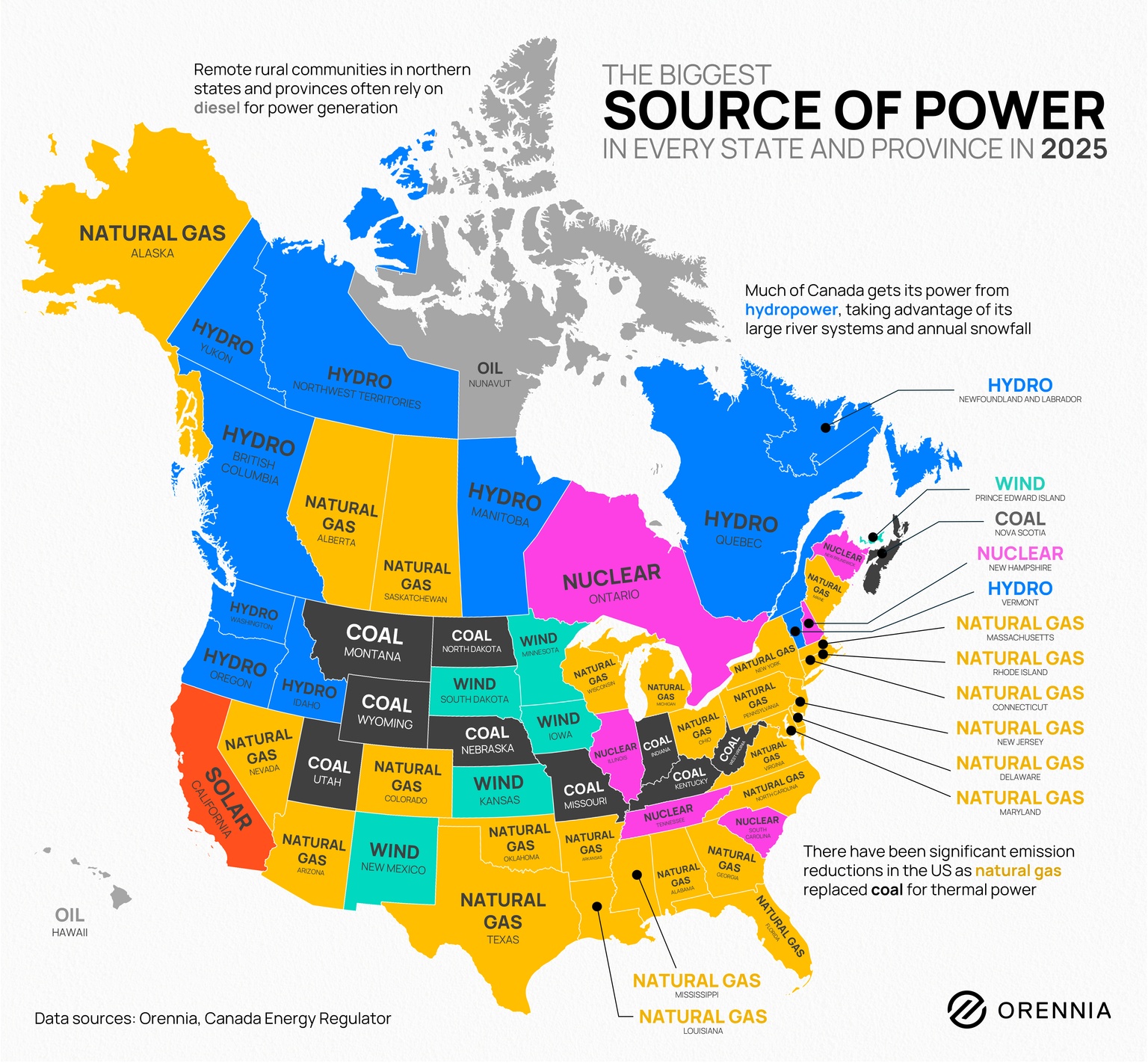
Power sources are historically tied to local resources. With so much variation in climate and geology across the US and Canada, there are several key energy regions.
Coal Country spans much of the US northeast, historically powering the country with its abundant coal reserves. While coal’s decline has reshaped the region, natural gas from the Marcellus shale is shifting its landscape.
A wind belt cuts across the central US and into Canada. Texas has been called the “Saudi Arabia of Wind,” while states like Iowa and Kansas regularly generate more than half their electricity from wind farms.
A solar belt stretches across the southwestern US, where states like California, Arizona, and Nevada have built some of the world’s largest solar farms. With the Mojave and Sonoran Deserts receiving some of the highest solar irradiance on Earth, large-scale solar installations have been used to harvest the energy.
Hydro potential dominates much of the north, with large reservoirs and generating stations supplying many parts of Canada and some US states. Though, droughts have affected the reservoirs over the past year, with Quebec moving from next exporter to net importer over the course of the year.
The news of the year:
California became the first state to generate more electricity from solar power than any other source. Solar eclipsed natural gas as the state’s adoption of batteries allowed for more solar to be absorbed into the system.
Newsletter Signup
Insights for an evolving energy landscape delivered to your inbox.