
Aaron Foyer
Director, Research
Aaron Foyer
Director, Research
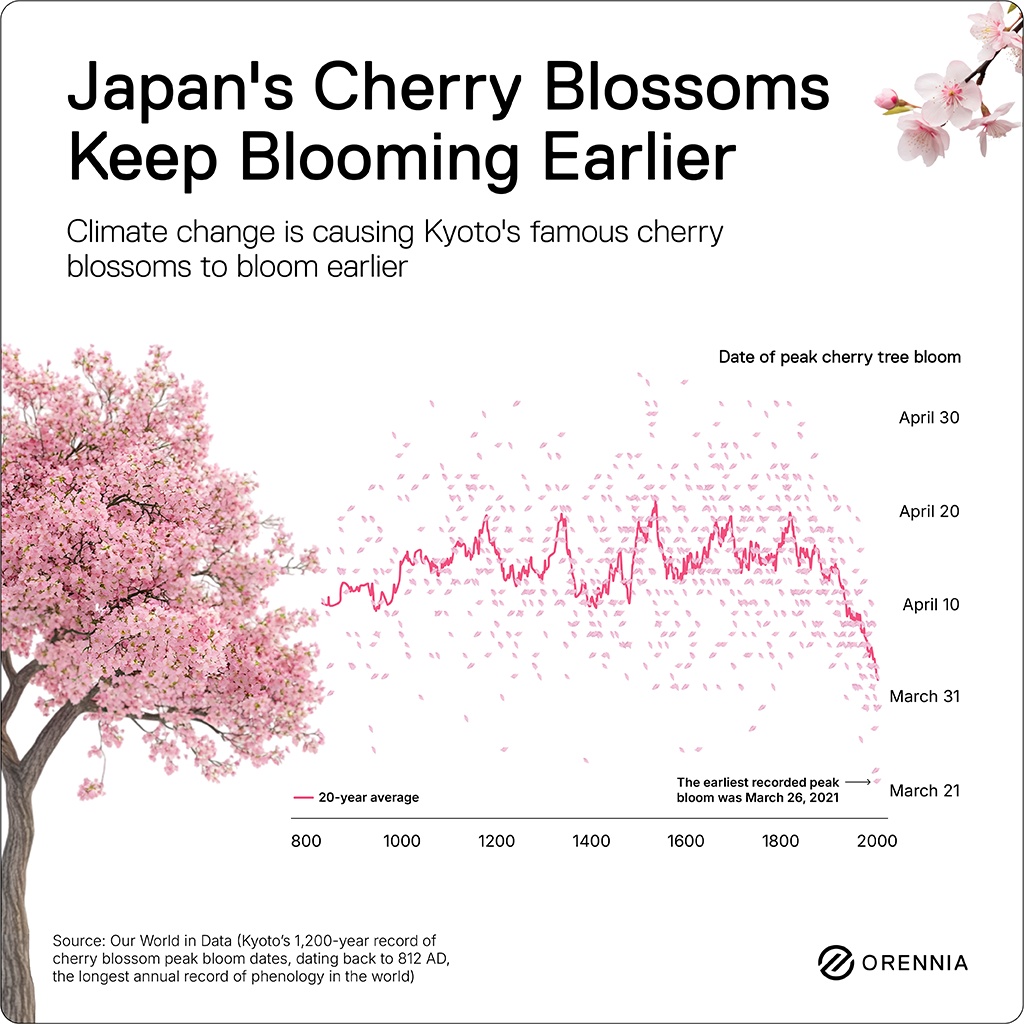
Cherry trees are living thermometers, with flowering cycle running on a two-stage temperature program that makes them sensitive to climate shifts.
The trees first need cold. Cherry blossom buds form during the summer of the preceding year and then pass through a dormancy period in the cold autumn and winter temperatures before they can begin growing again. They then need warmth. Once dormancy breaks, cumulative temperatures above a threshold drive the buds toward flowering, known as heat accumulation. The warmer and earlier the spring, the sooner the bloom.
The timing of cherry blossom blooms was documented in ancient diaries and chronicles maintained in Kyoto, the historical Japanese capital from 794 to 1868. Emperors, monks, and aristocrats recorded the precise dates of flower-viewing parties as a matter of cultural and ceremonial importance. Science was incidental.
The Kyoto dataset is probably the longest annual record of phenology from anywhere in the world. Historical information on the blossom date goes back to 812 AD, although nearly continuous records are not available until 1406 AD.
For most of recorded history, the bloom dates were remarkably stable. The average peak bloom date held relatively constant for roughly 1,000 years, from about 812 to 1800.
Researcher Yasuyuki Aono of Osaka Prefecture University, analyzing Kyoto weather data dating back to 812, found that temperature shifts, likely driven by a warming climate, have advanced the blooming of sakura by approximately three weeks, moving peak bloom from mid-April to mid-March.
Researchers increasingly believe that the blooming trees will shift towards the north as climate change warms the planet. Similar to the impact on Champagne grapes.
Insights for an evolving energy landscape delivered to your inbox.